TRUNK CATEGORY
This table makes it possible to define the different types of signaling that one can allocate to the trunks (see trunk attribute in TRUNK GROUP).
WARNING :
The modification of certain parameters (labelled BOARD PARAMETERS) in the following pages is only taken into account after the board reset.
CHANGE TRUNK TYPE
Trunk Category Id
Introduce the number of trunk COS.
On the initialization, the COS are as follows (example for France):
0
| Rotary 66_33 NDID
|
1
| DTMF NDID
|
2
| Rotary 66_33 Charging NDID
|
3
| DTMF Charging NDID
|
4
| DID
|
5
| Master colysee Tie line (MCOL )
|
6
| Slave colysee Tie line (SCOL )
|
7
| L0 Tie line
|
8
| Manual Tie line ( IS)
|
9
| E&M DID
|
10
| Master Colysee E&M Tie line (MCOL tron ron)
|
11
| Slave Colysee E&M Tie line (SCOL tron ron)
|
12
| E&M L0 Tie-line (L0 tron ron )
|
13
| Rotary 50 50 NDID
|
14
| Rotary 50 50 charging NDID
|
15
| Status Code Tie line (IA CE )
|
16
| T2
|
17
| T0
|
18
| ABC-F
|
19
| ISDN
|
20
| L1 Tie line
|
21
| DID/NDID-D
|
22
| Pulse code Tie line (IA CI)
|
23
| DASS2
|
24
| DPNSS
|
25
| DPNSS
|
26
| Rotary 66_33 NDID
|
30
| DC5
|
31
| Rotary 66_33 NDID
|
Connection Category ID
A connection COS is attributed to each trunk.
The connection COS (from 0 to 31) authorizes or prohibits the link between terminals (stations, trunks).
The communication rights concern the following features:
- call pick-up,
- outgoing, searching a free trunk by a station by seizing the trunk group or abbreviated dialing,
- incoming, routing a network on a station (including case of DISA),
- in tie-line transit, between the incoming trunk and the outgoing trunk.
Waiting Guide
YES: the music on hold is connected when a hold is activated.
NO: tone 55 is connected when the hold is activated.
Overflow Timer on No Reply
The overflow time-out is applied if, successively:
- the DID number requested does not respond,
OR the trunk routing number (NDID) (see routing directory number attribute in TRUNK ) does not reply,
- the routing numbers during activation (night, day, forward 1, forward 2 routing) do not reply.
The adjustment is made by number of units of 100 ms.
Overflow Timer on Waiting
The overflow time-out is applied if, successively:
- the busy DID number requested does not respond,
- the routing number of the NDID trunk is busy (see routing number attribute in TRUNK),
- the routing numbers during selection (night, day, forward 1, forward 2 - see TRUNK GROUP) are busy.
The adjustment is made by number of units of 100 ms.
Trunk Type
The choice is made from the menu :
NDID
Charging NDID
DID
E&M DID
LIA
Manual Tie Line (IS)
...
T2
T0
COMBINATION
DASS2
DPNSS
.......
WARNING :
It is not recommended to modify the type of trunk. If you really want to modify the trunk, you will not be able to cancel your modification (the corresponding values are changed into default values
MODIFICATION OF TRUNK TYPE.
If trunks are already allocated to trunk group, the modification is impossible.
If you absolutely want to modify the trunk type, you have to:
- if the case may be, remove the trunks from trunk group (see TRUNK),
- Activate the function CHANGE TRUNK TYPE,
- if need be, create the trunks again by allocating it to a compatible trunk group (see TRUNK).
Boards in which trunks are fitted
TRUNK
| BOARD
|
NDID
Charging NDID
| PCM
AT_LS
AT_UFS
NDID-D
NDID-A
NDID-EE
NDID-x (all)
SUVG ------- NDID4
------- NDID8
|
DID
| PCM
AT_LS
AT UFS
ATR2
ATQ23 DeD
DID-D
SUVG ------- DID
------- AT3W
|
DID E, M (SDATR)
| SUVG ------- DID (Not available)
|
DID R2 (SDAR2)
| PCM
ATR2
SUVG ------- SDAR2
------- AT3W
|
NDID R2 (BCAR2)
| PCM
ATR2
|
Colisée master Tie Line (IA_MCOL)
Colisée slave Tie Line (IA_SCOL)
| PCM
EMTL
ACEM
SUVG ------- ACTL2,
------- EMTL2
------- EMTL4
|
L0 Tie Line (IA_L0)
| PCM
EMTL
ACEM
SUVG ------- EMTL2
------- EMTL4
------- ACTL2
|
Status code Tie Line (IACE)
| LDTL_A_LOOP_LOOP
LDTL_A_FEED_FEED
LDTL_D_LOOP_LOOP
LDTL_D_FEED_FEED
EMTL
ACEM
SUVG ------- EMTL2
------- EMTL4
------- ACTL2
|
Pulse code Tie Line (IACI)
| EMTL
ACEM
PCM
SUVG ACTL2/EMTL2/EMTL4
|
PCM portugal (MICPO)
| PCM
|
IPNS
| PRA
BPRA
BRA
|
ISDN
| PRA
BPRA
BRA
|
ICNS
| PRA
BPRA
BRA
|
AC15A Tie Line
AC15C Tie Line
| SUVG ------- AD TL4
|
DC5 Tie Line
| PCM
ACEM
EMTL
SUVG ------- AD TL4
------- EMTL2
------- EMTL4
|
T2
| PRA (pos 0)
BPRA (pos 0)
|
T0
| BRA (pos 0 a 7)
BPRA (pos 1 a 3)
|
DPNSS (Special Great-Britain)
| PRA 2
|
DASS2 (Special Great-Britain)
| PRA 2
|
L1 Tie Line
| EMTL
SUVG ------ L1TL4
|
EMPULSE Tie Line
| ACEM
EMTL
SUVG ------ ACTL2
------ ACTL2D
------ EMTL2
------ EMTL4
|
Combination (MIXTE)
| PCM
EMTL AT-LS
|
MF CGCT
| PCM
|
Signalling Type
This attribute must be defined when the R2 type trunk is selected.
This attribute is only used with the trunks BCAR2, SDAR2, R2MFC. It defines the R2 register signaling type:
- not relevant
- R2 Q441
- R2 China
- R2 group C
NDDI Trunk
NDID Trunks is used if the Trunk type = NDID.
Exchange Type
(Specific to Austria)
The choice is made in a menu:
- W48 (special feature for Austria)
- W48U (special feature for Austria)
- OES (special feature for Austria)
- PCM connected to an analog remote exchange (Czech Republic)
- PCM connected to a digital remote exchange
- ...
Line Type
BOARD PARAMETER
To be used by specialists only.
This attribute makes it possible to adapt the electrical gain of the line
Short line: adjustment to suit short line low gain,Long line: adjustment to suit long line high gain,line 1: balancing adaptation for very short lines low gainline 2: balancing adaptation for short lines low gainline 3: balancing adaptation for medium 0.4mm type lines high gainline 4: balancing adaptation for medium 0.5 or 0.6mm type lines high gainline 5: balancing adaptation for long 0.4 mm type lines high gainline 6: balancing adaptation for medium 0.5 or 0.6mm type lines high gainline 7: reservedline 8: reservedWARNING :
The choice is fixed according to the country chosen for the board (see BOARDS object). Any modifications are to be carried out under Alcatel-Lucent control.
Wait for Seizure Ack.Timer
Maximum time during which the acknowledgement of receipt is waited when a line is seized before a fault message is generated.
When a fault is detected, the acknowledgement of receipt for the seizure or for an equivalent signal must be waited before releasing the trunk.
The adjustment is made by number of units of 100 ms.
Default Transmission
YES: the external dialing is transmitted as soon as the tone is detected or after the default transmission delay.
NO: the external dialing is transmitted as soon as the tone is detected by the DSP (trunk group seizure tone, intermediary national and international tones); if there is no tone, the system releases the trunk and takes another.
Default Transmission Delay
See the "default transmission" attribute
The adjustment is made by number of units of 100 ms.
Type of Numbering
The choice is made from a menu:
D66_33 (Decimal 66-33)D50_50 (Decimal 50-50)MFQ23
Digit Pulse Duration (ms)
BOARD PARAMETER
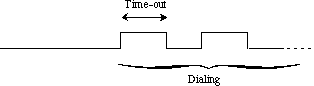
The adjustment is made by ms.
Digit Pause Duration (ms)
BOARD PARAMETER
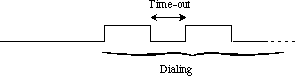
The adjustment is made by ms.
Interdigit Timer on Sending
This timer sets the amount of time between 2 analogic digits transmitted.
The adjustment is made by number of units of 100 ms.
End of Selection
Choice by a menu:
NO: the incoming trunk does not transmit the end of selection signalYES: the incoming trunk transmits the end of selection signal; the same signal is transmitted, whatever the called is free or busy.Free / Busy: the incoming trunk transmits the end of selection signal; a different signal is transmitted whether the called is free or busy.
Off-hook Presumption Timer
This time-out is to be controlled if the remote exchange does not send out a battery inversion signal or a charging signal reception,
At the end of this time-out, the outgoing call switches into "conversation" status allowing services to be taken into account (double call, transfer, conference, transparency to dialing...) and possible charging pulses.
The adjustment is made by number of units of 100 ms.
NOTE: No service (enquiry call, etc...) is available during this time-out.
Battery Inversion Masking
BOARD PARAMETER
The battery inversion masking concerns the reversal of the polarity when the called party answers, and the reversal of the polarity when the called party goes on-hook.
See Masking release
Masking Release
BOARD PARAMETER
All battery inversions can be masked except the first which indicates hook-off.
Battery inversion masking: NO
Masking release of battery (inversion): NO
Outgoing call: the 1st battery inversion is recognised as the response signal and the 2nd battery inversion is recognised as the release signal.
Incoming call: the 1st battery inversion is recognised as the release signal.
Battery inversion masking: YES
Masking release of battery (inversion): NO
The 1st battery inversion id recognised as the release signal. Any other battery inversions are not recognised.
Battery inversion masking: NO
Masking release of battery (inversion): YES
Outgoing call; the 1st battery inversion is recognised as the response signal
Incoming call: the battery inversions are not processed.
Battery inversion masking: YES
Masking release of battery (inversion): YES
The battery inversions are not processed.
Wait for Called Party Answer
YES : the trunk waits for the signal of answer before switching over to the conversational state (without answer, the call is cut when the "Wait for Called party Answer Timer" expires).
NO: the trunk switches over to the conversational state when the "Off hook-presumption Timer" (or other in function of the country) expires and it has not detected the answer signal.
Wait for Called Answer Timer
See the attribute Wait For Called Party Answer
The adjustment is made by number of units of 100 ms.
Charging on Answer
YES: the charging counter is incremented by 1 unit on called party answer.
Wait for Called Party Reanswer
YES: the "second answer" service makes it possible not to release the outgoing call line when the called party releases.
This will enable the remote called party to on-hook his set and pick up the call on another set in parallel.
Wait for Caller Release Timer
If the Caller does not go on-hook, this time-out makes it possible to control the time during which the system waits for the called party goes off-hook again before releasing the call.
The adjustment is made by number of units of 100 ms.
Unavailable Time Betw.2 Seizes
This timer manages the idle duration of the trunk between 2 consecutive calls. Any incoming calls during this timer are taken into account.
The adjustment is made by number of 100 ms units.
Loop Detection on Seizure
YES: After the outgoing call seizure has been made, the loop closure by remote exchange (feeding detection) is validated.
If the loop closure is not detected, another trunk is seized automatically and the faulty trunk is declared Out of Service.
The faulty trunk is then tested every two minutes.
Min.Incoming Seizure Time
BOARD PARAMETER
This is the minimum duration of the ringing current stream after which the incoming call seizure is considered as valid.
The adjustment is made by number of units of 10 ms.
Answer Signal Time
BOARD PARAMETER
Duration of the signal of called party answer.
The adjustment is made by number of units of 10 ms.
DDI Trunk
Is used if the Trunk type = DID
Line Signalling
BOARD PARAMETER
Possible choices:
- Default sig
- PCM Q421
- PCM Q421 type 2
- ...
Exchange Type
Possible choices:
W48 (Austria)W48U (Austria)OES (Austria)PCM connected to an remote analog ExchangePCM connected to a remote digital Exchange
Line Type
BOARD PARAMETER
To be used by specialists only.
This attribute makes it possible to adapt the electrical gain of the line
Short line: adjustment to suit short line low gain,Long line: adjustment to suit long line high gain,line 1: balancing adaptation for very short lines low gainline 2: balancing adaptation for short lines low gainline 3: balancing adaptation for medium 0.4mm type lines high gainline 4: balancing adaptation for medium 0.5 or 0.6mm type lines high gainline 5: balancing adaptation for long 0.4 mm type lines high gainline 6: balancing adaptation for medium 0.5 or 0.6mm type lines high gainline 7: reservedline 8: reserved
WARNING :
The choice is fixed according to the country chosen for the board (see BOARDS object). Any modifications are to be carried out under Alcatel-Lucent control.
Incoming Seizure Acknowledgment
Choice by a menu:
NO: the incoming trunk does not transmit the seizure acknowledgement signal.YES: the incoming trunk transmits the seizure acknowledgement signal to the remote trunk when the seizure acknowledgement transmission timeout expires.One pulse:Two pulses:One state changeTwo state changes
The selection of one of theses values depend on the protocol used; the incoming trunk transmits a seizure acknowledgement signal of the selected form.
The default preferred choice is YES.
Delay Before Sending Seizure Ack
See the Incoming Seizure Acknowledgment attribute
If this timeout is equal to 0, the seizure acknowledgement is transmitted immediately after the seizure signal is detected.
The value is incremented by steps of 100 ms.
Incoming DTMF Received
YES: dual tone multi-frequency reception
Delay Between Digits on Receiving
Maximum time when the system waits digits after the seizure confirmation signal has been transmitted or time when the system waits between two consecutive digits.
When this time-out expires:
in closed dialing: the call is released and an incident message is issued.In open dialing: the call is rerouted according to the routing table.
The adjustment is made by number of units of 100 ms.
Routing to Attendant
In open dialing, if the first received digit corresponds to the digit chosen for this parameter (0 to 9), the call is immediately routed according to the routing table. The system does not wait for the possible reception of other digits.
First Digit Authorized
If the first digit of the DID number received is not authorized, the communication is interrupted.
Number of Digits Received
The number of digits received (between 1 and 8) is the number of digits supplied by the public network for direct selection on arrival.
If this parameter is:
equal to 0, the DID is used in open dialing. In this case, DID transcoding cannot be used (see TRUNK GROUP-attribute DID transcoding,not equal to 0, the DID is used in closed dialing.
Number of Digits Used
The number of digits in the local directory cannot be the same as the number of digits on arrival. It is the number of digits needed by the system to be able to select the station.
The number of digits used can be of between 1 and 8 digits.
Example:
Range of DID nos provided by the public network: 4300 to 4399 /certain local: 300 to 399
The certain local coincides with the certain public network (no translation)Number of digits received = 4Number of digits used = 3
This parameter is not used in the case of transcoding (see TRUNK GROUP-DID transcoding attribute).
Open Dialling
Consult mode only.
YES: The attribute Number of Digits received is equal to 0.
End of Selection
Choice by a menu:
NO: the incoming trunk does not transmit the end of selection signal.YES: the incoming trunk transmits the end of selection signal; the same signal is transmitted, whatever the called is free or busy.Free / Busy: the incoming trunk transmits the end of selection signal; a different signal is transmitted, whether the called is free or busy.
Wait for Caller Release Timer
If the Caller does not go on-hook, this time-out makes it possible to control the time during which the system waits for the called party goes off-hook again before releasing the call.
The adjustment is made by number of units of 100 ms.
Seizure Validation Time
Maximal duration for waiting for the acknowledgement of receipt when a line is seized. When this time-out expires, a message of incident is transmitted.
When a fault is detected, the acknowledgement of receipt for seizure or an equivalent signal must be waited before the trunk is released.
The adjustment is made by number of units of 100 ms.
Loop Feeding Digit Break Time
BOARD PARAMETER
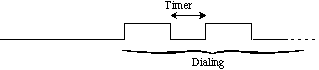
The adjustment is made by number of units of 2 ms.
Loop Feeding Digit Make Time
BOARD PARAMETER
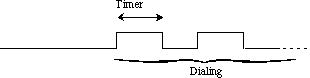
The adjustment is made by number of units of 2 ms.
Answer Signal Time
Duration of the signal of called party answer.
The adjustment is made by number of units of 100 ms.
Caller Release Validation Time
Duration of the pulse transmitted by the caller to acknowledge that the caller has hung up.
The adjustment is made by number of units of 100 ms.
Incoming Call Unavailable Time
Unavailability time-out between trunk release and the next incoming call (makes it possible to give greater importance to outgoing calls).
PCM PO Trunk
Used if the Trunk type = PCMPO.
Wait for Seizure Ack.Timer
Maximum duration for waiting for the acknowledgment of receipt during seizure before a fault message is displayed.
When a fault is detected, you must wait for the reception of the acknowledgement of receipt of seizure or an equivalent message before releasing the trunk.
The adjustment is made by number of units of 100 ms.
Type of Numbering
Possible choices
1 decimal dialing of type 66-33
2 decimal dialing of type 50-50
3 DTMF Q23
4 No dialing
Interdigit Timer on Sending
This timer programs the minimum Delay between 2 analog digits transmitted.
The adjustment is made by number of units of 100 ms.
Wait for Called Party Answer
YES: the trunk waits for the answer signal before changing into speech state (without answer, the call is cut at the end of the time-out "waiting for the called party answer").
NO: the trunk changes over to conversation state at the end of the "waiting for the called party answer" if the answer signal has not been detected
Wait for Called Answer Timer
See the attribute "Waiting for the called party answer".
The adjustment is made by number of units of 100 ms.
Release Method
Non-compelled Control: the first person who on-hooks releases the call.Calling Party Control: the called party can go on-hook and then off-hook (before the end of the Delay Waiting Called Party Re Answer), without ending the call, he remains connected with the calling party (if the calling party has not in fact on-hooked). Each time the called party goes on-hook, the Delay Waiting Called Party Re Answer is started.Called Party Control: the calling party can go on-hook and then off-hook without ending the call, he remains connected with the called party (if the called party has not in fact on-hooked).
There is no timer in this case (only Q421 type 2 line signaling)
According to the R2 signaling table: the release method is defined in the R2 SIGNALING TRANSLATION table according to the external number dialled.Release on 1st pulse: in impulse signaling, the 1st end which releases emits a pulse which returns the trunks to idle.
Wait for Caller Release Timer
If the Caller does not go on-hook, this time-out makes it possible to
control the time during which the system waits for the called party goes
off-hook again before releasing the call.
The adjustment is made by number of units of 100 ms.
Incoming DTMF Received
YES: In DTMF dialing, makes it possible to query a Q23 receiver before the signal of seizure confirmation is emitted.
Delay Between Digits on Receiving
Maximum time-out for waiting for the digits after the signal of confirmation of seizure or of waiting time between two consecutive digits is emitted.
At the end of this time-out, the call is released and a message of fault is displayed.
The adjustment is made by number of units of 100 ms.
First Digit Authorized
Digit 0
Digit 1
.......
Digit 8
Digit 9
NO: The number received from the public exchange and beginning by the corresponding digit is considered as wrong and the call is routed to the attendant.
Routing to Attendant
If the first digit received corresponds to that which was chosen for this parameter (0 to 9)(-1 for none), the call is immediately routed to the attendant without waiting for the reception of other digits.
Open Dialling
Consultation only
YES: the attribute Number of digits received is equal to 0.
Number of Digits Received
The Number of digits received (between 1 and 8) is the number of digits provided by the public network for the direct dialing incoming.
If this parameter is:
equal to 0, DID is used in open dialing. In this case, DID transcoding cannot be used (see TRUNK GROUPS - attribute DID transcoding),different from 0, the DID is used in closed dialing.
Number of Digits Used
The number of digits in the local directory can be different from the Number of digits received. This is the number of digits necessary for the system to be able to select the digit.
The Number of digits used can contain between 1 and 8 digits.
The default value is 3.
Example
Range of DID numbers provided by the public network : 4300 to 4399 / local hundreds: 300 to 399.
The local hundreds corresponds to the public network hundreds (no translation)Number of digits received = 4Number of digits used = 3This parameter is not used in the case of transcoding (see TRUNK GROUP-DID transcoding attribute).
R2 Trunk
Used if the trunk type is BCAR2, SDAR2, R2MFC, and the signaling type R2 Q441 or R2 group C or China R2.
Voice Guide - Busy Cd party
Voice guide is connected to the calling party instead of the "Busy subscriber" backward signal if the attribute "GRB signal transmission" is on NO (see the section DID R2 IMPR2 trunks).
(see the SYSTEM chapter - Voice guides).
Voice Guide - Inacc. Cd party
Voice guide is connected to the calling party instead of another backward signal than "Busy subscriber" or "Unknown called number" or "congestion" if the attribute "GRB signal transmission" is on NO" (see the section DID R2 IMPR2 trunks).
(see the SYSTEM chapter - Voice guides).
Voice Guide - Wrong Number
Voice guide connected to the calling party instead of the backward signal "Unknown called number" if the attribute "Group B signal transmission" (see section DID R2 IMPR2) is NO.
Congestion Voice Guide
Voice guide is connected to the calling party instead of the "Congestion" backward signal if the section "GRB signal transmission"is on NO (see the section DID R2 IMPR2 trunks).
(see the SYSTEM chapter - Voice guides).
Register Signalling
This section indicates whether recorder signaling is made in compelled or semi-compelled mode.
In compelled signaling, an after signal is emitted until it has been acknowledged by a before signal.
On receiving the backward signal the transmission of forward signal can stop and causes the backward signal to stop.
In semi-compelled signaling, the before signal which acknowledges the after signal is transmitted in the form of a pulse of programmable duration.
Possible choices :
Slave (compelled)Half-slave
Line Signalling
BOARD PARAMETER
Possible choices:
Default sigPCM Q421PCM Q421 type 2...
Exchange Type
Possible choices:
W48 (Austria)W48U (Austria)OES (Austria)PCM on remote Analog exchange (Czech Republic)PCM on remote Digital exchange
Line Type
BOARD PARAMETER
To be used by specialists only.
This attribute makes it possible to adapt the electrical gain of the line
Short line: adjustment to suit short line low gain,Long line: adjustment to suit long line high gain,line 1: balancing adaptation for very short lines low gainline 2: balancing adaptation for short lines low gainline 3: balancing adaptation for medium 0.4mm type lines high gainline 4: balancing adaptation for medium 0.5 or 0.6mm type lines high gainline 5: balancing adaptation for long 0.4 mm type lines high gainline 6: balancing adaptation for medium 0.5 or 0.6mm type lines high gainline 7: reservedline 8: reserved
WARNING :
The choice is fixed according to the country chosen for the board (see BOARDS object). Any modifications are to be carried out under Alcatel-Lucent control.
2 or 4 Voice Wires
BOARD PARAMETER
Possible choices :
- 2 - wire: the link is private type a, b for voice
- 4 - wire: the link is private type a, b, c, d for voice
Short Pulse Duration (x10ms)
BOARD PARAMETERS
This timer defines the duration of the short pulses emitted by the coupler (seizure, seizure acknowledgement, etc.).
Long Pulse Duration (x10ms)
BOARD PARAMETERS
This timer defines the duration of the long pulses emitted by the coupler (on-hooking, release).
NDDI R2 Trunk
Used if the Trunk type is NDID R2, R2MFC.
Outgoing Seizure Acknowledgment
Choice by a menu:
- NO: the outgoing trunk does not expect a seizure acknowledgement signal. When the seizure acknowledgement timeout expires, the first digit of the called number can be transmitted by the trunk.
- YES: the outgoing trunk expects a seizure acknowledgement signal of the remote trunk up to the expiration of the seizure acknowledgement timeout. If the seizure acknowledgement signal is not received, the outgoing trunk is released.
- One pulse
- Two pulses
- One state change
- Two state changes
The selection of one of these values depends on the protocol used; the outgoing trunk expects a seizure acknowledgement signal of the selected form.
The default and preferred selection is YES.
Seizure Acknowledgment Timer
Voir l'attribut Outgoing Seizure Acknowledgment
The adjustment is made by number of units of 100 ms.
Dial Tone Detection
YES: an invitation to transmit tone is expected from the remote before the dialing is emitted.
Default Transmission
YES: The external dialing is transmitted as soon as the tone is detected or after the default transmission time.
NO: The external dialing is transmitted as soon as the tone is detected by the DSP (trunk group seizure tone, intermediary national and international tones) the system releases the trunk and takes another.
Default Transmission Delay
YES: the trunk waits for the answer signal before changing into speech state (without answer, the call is cut at the end of the time-out "Waiting for the called party answer timer").
NO: the trunk changes over conversation state at the end of the "Waiting for the called party answer timer" if the answer signal has not been detected
Wait for Called Party Answer
YES : the trunk waits for the signal of answer before switching over to the conversational state (without answer, the call is cut when the "Wait for Called party Answer Timer" expires).
NO: the trunk switches over to the conversational state when the "Off hook-presumption Timer" (or other in function of the country) expires and it has not detected the answer signal.
Wait for Called Answer Timer
See the attribute "Waiting for the called party answer"
The adjustment is made by number of units of 100 ms.
Charging on Answer
YES: the charging counter is incremented by 1 unit on called party answer, regardless of the charging pulses received before.
Release Method
BOARD PARAMETER
Non-compelled Control: the first person who on-hooks releases the call.Calling Party Control: the called party can go on-hook and then off-hook (before the end of the Delay Waiting Called Party Re Answer), without ending the call, he remains connected with the calling party (if the calling party has not in fact on-hooked). Each time the called party goes on-hook, the Delay Waiting Called Party Re Answer is started.Called Party Control: the calling party can go on-hook and then off-hook without ending the call, he remains connected with the called party (if the called party has not in fact on-hooked).
There is no timer in this case (only in Q421 type 2 line signaling)
According to the R2 signaling table: the release method is defined in the R2 SIGNALING TRANSLATION table according to the external number dialled.Release on 1st pulse: in pulse signaling, the 1st end which releases emits a pulse which returns the trunks to idle.
Wait for Called Re-Answer Timer
If the calling party does not go on-hook, this time-out makes it possible to control the time during which the system waits for the called party goes off-hook again before releasing the call if the attribute Release method" is on Called Party Control (See the attribute Release method").
The adjustment is made by number of units of 100 ms.
Special Tones Receiving
YES: indicates the remote terminal to send a special tone or a voice guide to the caller, indicating that the number called cannot be reached because of congestion, inaccessible station or busy station.
In this case, there is no analysis of the reception of backward signals of group B.
T.for Compelling MF R2 Signals
This time-out makes it possible to manage either the waiting of reception of a backward signal following the transmission of an forward signal, or the waiting of the disappearance of a backward signal due to the stopping of an forward signal
After this time-out, a fault status is displayed and the call is released.
The adjustment is made by number of units of 100 ms.
Max.Tim.Without Send Signals
This timer is used to manage the maximum duration with no transmission of a group I or II forward signal. After this timer, a fault status is displayed and the call is released.
The adjustment is made by number of units of 100 ms.
Max.Duration Of Pulse
This time-out makes it possible to test the maximum length of the pulse received and to display a fault status and release the call in case it exceeds the length.
The minimal duration of recognition of a pulse is that of the receiver R2, that is to say 40 ms.
The adjustment is made by number of units of 100 ms.
PABX Call No.
A234 use:
Digits indicated in this section will be sent during the identification of the caller to the central.
Standard case:
it is not this attribute but the installation numbers in the entities which must be managed.
Nb Of Digits In Partial Identif.
This is the number of digit transmitted by the PABX when the incoming end asks for a partial identification of the calling party.
NDDI R2 Group I Signals
Used if the trunk type is NDID R2, R2MFC
Caller Subscriber Category
Group I signal transmitted in response to the signal to indciate that the call comes from a PABX user used in China R2).
Request Not Accepted
Signal of group I indicating the PABX is subjected to a request it cannot comply with.
End Of Caller Identification
Signal of group I transmitted by the PABX indicating the end of transmission of the sequence which identifies the line of the calling subscriber.
End Of Called Party Dialling
This group I signal sent by the PABX indicates the end of transmission of the called party number. This signal is sent after reception of the group A signal requesting transmission of the next digit in the following cases:
Automatically if the outgoing trunk is compatible with the Translator and the number of the digit already sent corresponds to the limit of the translator,Following composition of the Eauivalent to End of dialing character and after pressing on the dynamic key EndNum,At the end of the time-out period if the requesting using does not perform any action.
NDDI R2 Group II Signals
Used if the type of trunk is NDID, R2MFC and with signaling type R2 Q441 or R2 group C.
Attendant
Signal of group II transmitted by the PABX indicating that the calling party is an attendant.
Data Transmission
Signal of group II transmitted by the PABX indicating that the connection is used by a data transmission equipment.
NDDI R2 Group II Signals
Used if the trunk type is NDID R2, R2MFC, with signaling type R2 China.
Toll Call
Group II signal transmitted by the PABX to indicate a toll call.
Local Call Voice
Group II signal transmitted by the PABX to indicate a toll call.
Local Call Fax or Data
Group II signal transmitted by the PABX to indicate a local fax or data call.
NDDI R2 Group A Signals
Used if the type of trunk is NDID R2, R2MFC
Send Next Digit Called Party
Signal of group A received by the PABX which asks for transmission after it has received the digit "n", the following digit (n+1), allows it to identify the calling party.
Send Last But 1 Digit
Signal of group A received by the PABX which asks to send the next digit to the last digit send (n-1).
End Of Dialling & Wait B Signal
Signal of group A received by the PABX indicating that the remote exchange needs no more additional address digit and asking the PABX to transmit a group II
Congestion
Signal of group A received by the PABX and which indicates the call set-up has stopped, due to a problem of frequency R2 exchange and that the call will be released.
Caller Category Request
The information transmitted is:
either a group II signal corresponding to the calling party COS,or the partial identification of the calling party if the caller COS has already been transmitted and if the "complete calling party identification " section is not filled.or the complete identification of the calling party if the caller COS has already been transmitted, if the "complete calling party identification" section is filled and if the "partial calling party identification" section is not filled.
Complete Dialling & Conversation
Signal of group A received by the PABX which indicates the public exchange does not need additional address digits and which asks the PABX to be set on "waiting for the caller answer".
Send Last But 2 Digit
Signal of group A received by the PABX which asks for transmission of the antepenultimate digit (n-2), "n" is the last digit sent.
Send Last But 3 Digit
Signal of group A received by the PABX which asks for transmission of the digit preceding the antepenultimate digit (n-3), "n" is the last digit sent.
Send First Digit
Signal of group A received by the PABX which asks for transmission of the first digit of the number requested.
Send Last Digit
Signal of group A received by the PABX which asks for re-transmission of the last digit sent (n).
Complete Caller Identification
Signal of group A received by the PABX which asks for transmission of the complete identification of the calling party, i.e. the transmission of the digits one by one - which make the complete directory number of the station - one after the other while this signal is repeated until the signal of end of identification is received by the calling party.
Partial Caller Identification
Signal of group A received by the PABX which asks for transmission of the partial identification of the calling party, i.e. the transmission of the digits one by one - which make the complete directory number of the station - one after the other while this signal is repeated until the signal of end of identification is received by the calling party.
Send Next Digit Caller
Group A signal received by the PABX requesting transmission, after reception of digit "n", the next digit "n+1"of the calling party No.
Wrong Called Number
Group A signal received by the PABX indicating that the number requested does not exist.
NDDI R2 Group B Signals
Used if the type of trunk is NDID R2, R2MFC
B-1
- Free Called Party charged
indicates that the called party is free and the call is charged.
- Free Called Party uncharged
indicates that the called party is free and the call is not charged.
- Called Party busy
indicates that the called party is busy. The voice guide or busy tone are connected if the "special tone reception" attribute is set to NO.
- Called Party Inaccessible
indicates that the called party is inaccessible. The voice guide or inaccessible called party tone are connected if the "special tone reception" attribute is set to NO.
- Congestion
indicates that the call could not be established because of congestion problems. The voice guide or congestion tone are connected if the "special tone reception" attribute is set to NO.
- Called Party free Malicious call check
indicates that the called party is free. The release of this call is checked by the called party. The call is not released if the calling party on-hooks.
- Called Party number non-existant
indicates that the called party does not exist. The voice guide or the Inexisting no. tone are connected if the "special tone reception" atribute is set to NO.
B-2
B-3
B-4
B-5
B-6
B-7
B-8
B-9
B-10
B-11
B-12
B-13
B-14
B-15
NDDI R2 Group C Signals
Used if the type of trunk is NDID R2, R2MFC and with signaling type R2 group C.
Send First / Next Digit Caller
Group C signal received by the PABX requesting the transmission of the first digit and then the next digits of the calling party number.
Change in Gr.A, Send First Digit
Group C signal received by the PABX requesting retransmission of the first digit of the called number, and then moving to transmission of group A signals.
End Of Dialling & Wait B Signal
Group C signal received by the PABX, indicating that the remote public exchange no longer requires a further address digit and requesting the PABX to send a group II signal.
Congestion
Group C signal received by the PABX, indicating that call setup has been interrupted, following a problem relating to the exchange of R2 frequencies, and that the call will be cleared.
Change in Gr.A, Send Next Digit
Group C signal received by the PABX requesting transmission of the next (n+1) digit to enable it to identify the called party and then change to transmission of group A signals.
Change in Gr.A, Send Last Digit
Group C signal received by the PABX requesting retransmission of the last sent called number digit (n) and then change to transmission of group A signals.
NDDI R2 Trunk (continued)
Used if the type of trunk is NDID R2, R2 MFC
Called Release Val.Time
BOARD PARAMETER
Validation timer of the release by remote called party signal.
This timer supervises the "called party on-hooking" signal.
The adjustment is made by number of units of 10 ms.
Called Answer Val.Timer
BOARD PARAMETER
Duration of waiting for the called party answer signal.
The adjustment is made by number of units of 10 ms.
Malicious Call Val.Max.Timer
BOARD PARAMETER
Max.Timer of Malicious Call Signal Validation
The adjustment is made by number of units of 10 ms.
Malicious Call Val.Min.Timer
BOARD PARAMETER
Min.Timer of Malicious Call Signal Validation
The adjustment is made by number of units of 10 ms.
Malicious Call Signal Time
BOARD PARAMETER
The adjustment is made by number of units of 10 ms.
Unavailable T.Betw.2 Seizes
BOARD PARAMETER
For incoming calls to have priority, a time-out must be set between a trunk release and the next outgoing seizure.
The adjustment is made by a number of 100 ms units.
NDDI Not R2 Trunk With DDI R2
Used if the type of trunk is DID R2
Default Transmission
YES: The external dialing is transmitted as soon as the tone is detected or after the default transmission time.
NO: The external dialing is transmitted as soon as the tone is detected by the DSP (trunk group seizure tone, intermediary national and international tones) the system releases the trunk and takes another.
Default Transmission Delay
See the attribute "default transmission".
The adjustment is made by a number of 100 ms units.
Type of Numbering
The choice is made from a menu:
D66_33 (Decimal 66-33)D50_50 (Decimal 50-50)MFQ23
Wait for Called Answer Timer
See the attribute "Called Answer Validation".
The adjustment is made by number of units of 100 ms.
DDI R2 Trunk
DID R2 IMPR2 Trunks is used if the Trunk type = DID R2, IMPR2, ETATR2.
Incoming Seizure Acknowledgment
Choice by a menu:
- NO: the incoming trunk does not transmit the seizure acknowledgement signal.
- YES: the incoming trunk transmits the seizure acknowledgement signal to the remote trunk when the seizure acknowledgement transmission timeout expires.
- One pulse
- Two pulses
- One state change
- Two state changes
The selection of one of these values depends on the protocol used; the incoming trunk transmits the seizure acknowledgement signal of the selected form.
The default and preferred selection is YES.
Delay Before Sending Seizure Ack
See the Incoming Seizure Acknowledgment attribute
If this timeout is equal to 0, the seizure acknowledgement is transmitted immediately after the seizure signal is detected.
The value is incremented by steps of 100 ms.
Dial Tone Connection
YES: transmission of dial tone to the remote party.
Number of Digits Received
If this number is equal to 0, this is an open dialing with local translation after each digit received, without taking into account a possible DID translation and the parameter "number of digits used".
If the number is different from 0, it indicates the number of digits (0 to 8) provided by administration for Direct dialing Income (DID).
Number of Digits Used
The number of digits in local directory may be different from the the Number of digits received. This is the number of digits needed by the system to select the station (0 to 4).
This parameter is to manage if the parameter "Number of digits received" is different from 0 and if there is no DID translation on the level of the trunk group (see TRUNK GROUPS - DID transcoding).Example
Range of DID numbers provided by the public network : 4300 to 4399 / local hundredth: 300 to 399.
- local hundredth corresponds to the hundredth of the public network (no transcoding).
- Number of digits received = 4
- Number of digits used = 3
This parameter is not used in the case of transcoding (see TRUNK GROUP-DID transcoding attribute).
Routing to Attendant
In open dialing, if the first digit received corresponds to the digit chosen for this parameter (0 to 9), the call is immediately routed to the routing table without waiting for the possible reception of other digits.
Open Dialling
Consultation only
YES : the attribute Number of digits received is equal to 0
Ringback Tone Connection
YES: The system transmits the ringing tone to the calling party after the Timer before sending the call return signal .
Time Before Send Ringback Tone
See the attribute "ringing tone connection".
The adjustment is made by number of units of 100 ms.
Forced Release
YES: If the transmission of a signal backward is not stopped by the remote system, following the transmission of an forward signal of group A or B, the PABX transmits the signal of forced release before the signal of availability.
Forced Release Timer
This time-out makes it possible to manage the duration of transmission of the forced release signal in the case the section "forced release" is validated.
The adjustment is made by number of units of 100 ms.
Send Called Party Answer
YES: sends the called party off-hook response signal.
Release Method
BOARD PARAMETER
Non-compelled Control: the first person who on-hooks releases the call.Calling Party Control: the called party can go on-hook and then off-hook (before the end of the Delay Waiting Called Party Re Answer), without ending the call, he remains connected with the calling party (if the calling party has not in fact on-hooked). Each time the called party goes on-hook, the Delay Waiting Called Party Re Answer is started.Called Party Control: the calling party can go on-hook and then off-hook without ending the call, he remains connected with the called party (if the called party has not in fact on-hooked).
There is no timer in this case (Q421 type 2 line signaling only)
According to the R2 signaling table,: the release method is defined in the China DID R2 Group II signals signaling table.Release on 1st pulse: in pulse signallling, the 1st end which releases emits a pulse which returns the trunks to idle.
Wait for Called Re-Answer Timer
See the attribute Release method.
The adjustment is made by number of units of 100 ms.
Intrude On Busy Cd party
YES: Authorizes the overflow of an incoming call to the attendant if the called party subscriber is busy, on explicit request of the calling party.
Intrude On Cd party Hang Up
YES: Authorizes the routing of an incoming call to the attendant after the called party has hang up, on explicit request of the calling party.
Groupe B Signal Transmission
YES: Indicates that the PABX, once it has received all the digits to identified the called party, will send the signal "End of dialing and wait for B signal" and will exchange signals of group II and B.
NO: the PABX transmits the signal "Completed dialing and conversation" and then the different voice guide or tones if necessary.
Caller Identification
Possible choices:
Not Requested: the PBX does not request the calling party identificationAfter First Digit of Called Number: Indicates if the PABX is going to begin the sequence for calling party identification after receiving the first digit of called party number.After Last Digit of Called Number: Indicates if the PABX is going to begin the sequence for calling party identification after receiving the called party number.
Time Before 1st Digit Detection
After a receiver R2 backward has been selected, the system starts this time-out in order to stabilize the exchanges between receivers R2 and trunk.
Then it can wait for the first digit of the number called.
The adjustment is made by number of units of 100 ms.
Delay Between Digits on Receiving
This time-out makes it possible to manage the waiting of an forward signal of group I, following the transmission of the backward signal. If this time-out is exceeded, a fault status is displayed and the call is released.
The adjustment is made by number of units of 100 ms.
Time Wait.For Group II Signal
This time-out makes it possible to manage the duration of the signal of group II, following the stopping of the "end of dialing and change over group B" signal or stopping of the "caller COS request".
The adjustment is made by number of units of 100 ms.
Pulse Transmission Duration
This time-out makes it possible to set the duration of pulses, the form in which all backward signals of PABX are transmitted when this one operates in semi-compelled mode.
The adjustment is made by number of units of 100 ms.
Compelling Timer
This time-out makes it possible to control the duration of waiting for the removal of an signal of group I or II, following the transmission of the backward signal.
The adjustment is made by number of units of 100 ms.
DDI R2 Group I Signals
Used if the type of trunk is DID R2, R2MFC.
Request Not Accepted
Group I signal received by the PABX indicating the remote central is subjected to a request it cannot comply with.
End Of Caller Identification
Group I signal transmitted by the PABX indicating the end of transmission of the sequence which identifies the calling subscriber's number.
End Of Called Party Dialling
Group I signal received by the PABX indicating the end of transmission of the called party number. The PABX replies by transmitting the group A signal End of dialing and changes to group B or to conversation.
DDI R2 Group II Signals
Used if the trunk type is DID R2, R2MFC and with signaling type R2 Q441 or R2 group C.
II-1
- Attendant
on reception of a group II signal of the same value, the call is directed to the attendant following the routing table.
- Normal routing
on reception of a group II signal of the same value, the call is directed in the normal way to the requested subscriber using the VOICE.
- Data routing
on reception of a group II signal of the same value, the call is directed to the requested subscriber using the DATA.
- No routing
on reception of a group II signal of the same value, the congestion is sent, the communication is released.
II-2
Indicates that, on reception of a group II signal of the same value, the PABX starts a caller identification sequence if the attribute 'caller identification' is set at YES.
DDI R2 Group II Signals
Used if the trunk type is DID R2, R2/MFC and with signaling type China R2
II-1
Type of call received and release method for each group II value:
- No routing
- Toll Call - No Control
- Toll Call - Called Party Control
- Toll Call - Calling party Control
- PCX CallVoice - No Control
- PCX Call Voice - Called Party Control
- PCX Call Voice - Calling party Control
- PCX Call Fax or Data
Release method - definition
- no control: the first person who on-hooks releases the call.
- Calling Party Control: the called party can go on-hook and then off-hook (before the end of the Wait for called party ReAnswer timer - see trunk type DID R2), without ending the call, he remains connected with the calling party (if the calling party has not in fact on-hooked).
- Called Party Control: the calling party can go on-hook and then off-hook (before the end of the Timer), without ending the call.
II-2
indicates that, on reception of a group II signal of the same value, the PABX starts a caller identification sequence if the attribute 'caller identification' is set at YES.
If the PABX receives a group II signal which is not in one of these tables, the call is established without caller identification.
II-3
II-4
II-5
II-6
II-7
II-8
II-9
II-10
II-11
II-12
II-13
II-14
II-15
Caller Subscriber Category
DDI R2 Group A Signals
Used if the trunk type is DID R2, R2/MFC
Send Next Digit Called Party
Signal of group A transmitted by the PABX after it has received the digit "n" which asks for transmission, the following digit (n+1), allows it to identify the calling party.
Choose the signal transmitted from the following values: R2AR_F1, R2AR_F2 ... R2AR_F10
End Of Dialling & Wait B Signal
Signal of group A transmitted by the PABX indicating that the public exchange needs no more additional address digits and that the PABX tis about to transmit a group B signal.
Choose the signal transmitted from the following values: R2AR_F1, R2AR_F2 ... R2AR_F10
Congestion
Signal of group A transmitted by the PABX indicating that it has received an incorrect digit or has not received a digit during the transmission of the calling party's number or during the caller identification.
Gr.I or Gr.II Signal Not Receiv.
Signal of group A transmitted under the form of a pulse even if the signaling of recorders is in compelled mode and indicating that the PABX has not received signal of group I or II.
Caller Category Request
Signal of group A transmitted by the PABX and indicating that it asks for the transmission of a group II signal it uses to identify the calling party COS.
Caller Identification
Group A response signal emitted by the PABX which requests the transmission of the 1st digit in the calling party number.
Send Next Digit Caller
Signal of group A transmitted by the incoming PABX and indicating that it asks for the transmission of the calling party`s next digit "n+1", after reception of the digit "n".
Complete Dialling & Conversation
Signal of group A transmitted by the PABX which indicates that it does not need digits anymore and that it does not send signals of group B.
DDI R2 Group B Signals
Used if the trunk type is DID R2, R2/MFC.
Signal of group B informing the public attendant that the current call must not be released by him but by the PABX. This feature is used in particular cases (Fire, police, etc ...) to identify the caller.
Specific Tone Sent To Caller
Signal of group B transmitted by the PABX which indicates the special information tone must be sent to the calling party to point out that the calling number cannot be reached for other reasons that the ones provided by the other specific signal of group B.
Called Party Busy
Signal of group B transmitted by the PABX which indicates that the line(s) of the user called are busy.
Congestion After Change in Gr.B
Signal of group B transmitted by the PABX indicating that it has received a wrong group II signal.
Wrong Called Number
Signal of group B transmitted by the PABX which indicates that the number called is not used
Called Party Free Charged
Signal of group B transmitted by the PABX which indicates that the subscriber line is free and that the answer causes the call metering to start up.
Called Party Free Non Charged
Signal of group B transmitted by the PABX which indicates that the subscriber line is free and that the answer does not causes the call metering to start up.
Out Of Service Subscriber Line
Signal of group B transmitted by the PABX which indicates the line of the called party number has failed or is out of service.
Toll Free Call
This attribute is subject to rights (see PUBLIC NETWORK COS).Signal of group B transmitted by the PABX informing the public operator that the caller must not be metered.
Collect Calls Restriction
This attribute is subject to rights (see TRUNK GROUPS and PUBLIC NETWORK COS).Signal of group B transmitted by the PABX asking the public attendant to release the line if the current call is a call with 'authorized dde metering restriction' (refer to the definition in TRUNK GROUPS- Authorized dde accounting facility).
DDI R2 Group C Signals
Used if the trunk type is DID R2, R2/MFC and with signaling type R2 group C.
Send First / Next Digit Caller
Group C signals emitted by the PABX, requesting to send the first digit then the following digits of the calling party.
End Of Dialling & Wait B Signal
Group C signal emitted by the PABX, indicating that it no longer needs the supplementary address digit and that it is on the point of changing to transmission of a group B signal.
Congestion
Group C signal emitted by the PABX, indicating that it has recieved a wrong digit or has not received a digit, during identification of the calling party.
DDI R2 Trunk (continued)
Used if the trunk type is DID R2.
Seizure Validation Time
BOARD PARAMETER
Validation timer of caller release signal.
The adjustment is made by number of units of 10 ms.
Caller Release Validation Time
BOARD PARAMETER
The adjustment is made by number of units of 10 ms.
Max.Attend.signal valid Time
BOARD PARAMETER
Maximal duration of validation of the signal generated by the remote exchange attendant following the call of a busy subscriber in the PABX.
The adjustment is made by number of units of 10 ms.
Min.Attend.signal valid.Time
BOARD PARAMETER
Minimum duration of validation of the signal generated by the remote exchange attendant following the call of a busy subscriber in the PABX.
The adjustment is made by number of units of 10 ms.
Incoming Call Unavailable Time
BOARD PARAMETER
Unavailability timer between trunk release and the next incoming call
The adjustment is made by number of units of 10 ms.
Answer Signal Time
BOARD PARAMETER
Duration of the signal of called party answer.
The adjustment is made by number of units of 10 ms.
Malicious Call Signal Time
BOARD PARAMETER
The adjustment is made by number of units of 10 ms.
Tie Line Trunks
Used if the trunk type is MCOL, SCOL, IACE, L0, L1, IACI, AC15A, DC5, AC15C.
Type of Numbering
The choice is made from a menu:
- D66_33 (Decimal 66-33)
- D50_50 (Decimal 50-50)
- DTMFQ23
Delay Before Availability
This timer manages the duration the trunk is idle between 2 consecutive calls. Any incoming calls which are detected during this timer are taken into account.
The adjustment is made by number of units of 100 ms.
Delay Between Digits on Receiving
Maximum time to wait for a digit after transmission of the seizure confirmation signal or waiting timer between two consecutive digits.
When this timer expires, the call is released and a fault message is output.
The adjustment is made by number of units of 100 ms.
Dial Tone Connection
YES: sends the "ready-to-receive" tone to the remote terminal.
Ringback Tone Connection
YES: sends a ringback tone to the remote terminal.
Incoming DTMF Received
YES: in DTMF dialing, search for a DTMF receiver before transmission of the seizure confirmation signal.
Line Type
BOARD PARAMETER
Attribute used by EMTL/ACEM boards
This section makes it possible to adapt the electrical gain of the out-going line
Short Line: gain decreaseLong Line: gain increase...
Digit Pulse Duration (ms)
BOARD PARAMETER
The adjustment is made by ms.
Digit Pause Duration (ms)
BOARD PARAMETER
The adjustment is made by ms.
2 or 4 Voice Wires
BOARD PARAMETER
Attribute used by EMTL/ACEM boards.
You must choose from the menu:
2 - wire: the link is private type a, b for the voice4 - wire: the link is private type a, b, c, d for the voice
End of Selection
Choice by a menu:
NO: the incoming trunk does not transmit the end of selection signal.YES: the incoming trunk transmits the end of selection signal; the same signal is transmitted, whatever the called is free or busy.Free / Busy: the incoming trunk transmits the end of selection signal; a different signal is transmitted, whether the called is free or busy.
MCOL/SCOL Tie Line Trunks
Tie Line MCOL SCOL Trunks is used if the Trunk type = MCOL, SCOL.
Type 4 Wires
BOARD PARAMETER
The selection is carried out from the menu:
- E, M.
- 50 Hz
- 25 Hz
- ...
Outgoing Seizure Acknowledgment
Choice by a menu:
- NO: the outgoing trunk does not expect a seizure acknowledgement signal. When the seizure acknowledgement timeout expires, the first digit of the called number can be transmitted by the trunk.
- YES: the outgoing trunk expects a seizure acknowledgement signal of the remote trunk up to the expiration of the seizure acknowledgement timeout. If the seizure acknowledgement signal is not received, the outgoing trunk is released.
- One pulse
- Two pulses
- One state change
- Two state changes
The selection of one of these values depends on the protocol used; the outgoing trunk expects a seizure acknowledgement signal of the selected form.
The default and preferred selection is YES.
Incoming Seizure Acknowledgment
Choice by a menu:
NO: the incoming trunk does not transmit the seizure acknowledgement signal.YES: the incoming trunk transmits the seizure acknowledgement signal to the remote trunk when the seizure acknowledgement transmission timeout expires.One pulseTwo pulsesOne state changeTwo state changes
The selection of one of these values depends on the protocol used; the incoming trunk transmits the seizure acknowledgement signal of the selected form.
The default and preferred selection is YES.
Seizure Acknowledgment Timer
See the Outgoing Seizure Acknowledgment attribute
The value is incremented by steps of 100 ms.
Delay Before Sending Seizure Ack
See the Incoming Seizure Acknowledgment attribute
If this timeout is equal to 0, the seizure acknowledgement is transmitted immediately after the seizure signal is detected.
The value is incremented by steps of 100 ms.
Delay Before Outdialling
Time-out which makes it possible to delay the transmission of the first digit after receiving the proceed to send signal. It also makes it possible to transmit by default the status code Tie line.
The adjustment is made by number of units of 100 ms.
Delay Between Digits on Sending
This time-out programs the delay between each digit transmitted.
The adjustment is made by number of units of 100 ms.
Send Reply
YES: sends the signal of answer when the called party goes off-hook
Wait for Reply Timer
Time-out after which the change over conversation is performed if the remote terminal does not transmit an answer signal. The network-to-network transfer is impossible if value = 0.
The adjustment is made by number of units of 100 ms.
Ignore Call Conflict
When a communication is made on a TL pulse protocol, if a pulse is received by the caller less than 100 ms after the seizure pulse has been transmitted, it is considered as an incoming call (thus a conflict) and the outgoing call is abandoned.
In certain countries, depending on the protocol, the proceed to send arrives within these 100 ms.
In this case, the call must not be considered as a conflict but accepted.
After an outgoing seizure, the reception of a pulse:
NO: is considered as a conflict and causes the outgoing call to be abandoned.
YES: is considered as a proceed to send, the outgoing call is accepted.
ITTR feature / DC5A Inverted
IACE Tie Line Trunks
Used if the Trunk type is IACE.
Outgoing Seizure Acknowledgment
Choice by a menu:
- NO: the outgoing trunk does not expect a seizure acknowledgement signal. When the seizure acknowledgement timeout expires, the first digit of the called number can be transmitted by the trunk.
- YES: the outgoing trunk expects a seizure acknowledgement signal of the remote trunk up to the expiration of the seizure acknowledgement timeout. If the seizure acknowledgement signal is not received, the outgoing trunk is released.
- One pulse
- Two pulses
- One state change
- Two state changes
The selection of one of these values depends on the protocol used; the outgoing trunk expects a seizure acknowledgement signal of the selected form.
The default and preferred selection is YES.
Incoming Seizure Acknowledgment
Choice by a menu:
NO: the incoming trunk does not transmit the seizure acknowledgement signal.YES: the incoming trunk transmits the seizure acknowledgement signal to the remote trunk when the seizure acknowledgement transmission timeout expires.One pulseTwo pulsesOne state changeTwo state changes
The selection of one of these values depends on the protocol used; the incoming trunk transmits the seizure acknowledgement signal of the selected form.
The default and preferred selection is YES.
Seizure Acknowledgment Timer
See the Outgoing Seizure Acknowledgment attribute
The value is incremented by steps of 100 ms.
Delay Before Sending Seizure Ack
See the Incoming Seizure Acknowledgment attribute
If this timeout is equal to 0, the seizure acknowledgement is transmitted immediately after the seizure signal is detected.
The value is incremented by steps of 100 ms.
Dial Tone Detection
YES: an invitation to transmit tone is expected from the remote before the dialing is transmitted.
Default Transmission
YES : The external dialing is transmitted as soon as the tone is detected or after the default transmission time.
NO: The external dialing is transmitted as soon as the tone is detected by the DSP (trunk group seizure tone, intermediary national and international tones) the system releases the trunk and takes another.
Delay Before Outdialling
Time-out which makes it possible to delay the transmission of the first digit after receiving the proceed to send signal.
It also makes it possible to transmit by default the status code IA.
The adjustment is made by number of units of 100 ms.
Receiving the Dialling
YES: the circuit is used as automatic tie-line.
NO: the circuit is used as manual tie line.
Delay Between Digits on Sending
This time-out programs the delay between each digit transmitted.
The adjustment is made by number of units of 100 ms.
Busy Tone Connection
YES: the busy tone is transmitted to the remote user (for example a wrong number has been dialed or the station is busy).
Send Reply
YES: sends the signal of answer when the called party goes off-hook (if taken into account by the remote terminal).
Reply by Pulse
YES: signal sent as a pulse.
Delay Waiting for Reply
Time-out after which the change over conversation is performed if the remote terminal does not transmit any answer signal. The network-to-network transfer is impossible if value = 0-0.
The adjustment is made by number of units of 100 ms.
ITTR feature / DC5A Inverted
See country specificities.
Controlled Release
YES : the trunk is released after the signal for remote terminal release is received.
Release Acknowledge Timer
After going on-hook on incoming or outgoing call (M=0): the system waits for the remote terminal on-hook. confirmation (E=0).
If, when this timer expires, the on-hook confirmation has not been received, the incident number 1241 is issued and the system waits forever for the on-hook confirmation.
Input Output Level
(Unused on EMTL and ACEM boards)
Choose in the following list:0 Trunk (0),
1 Subscriber (1),
2 TieLine (2).
The I/O level corresponds to the attenuation/amplification level of electrical signals for adapting them in function of the line state or the distance between PABXs.
Trunk Type
(Unused on EMTL and ACEM boards)
The selection is carried out from the menu:
IA_LOOP (Type of signaling of current loop),IA_FEEDING (Type of signaling of battery inversion).
Paging
YES: the equipment works in paging
NO: the equipment works in Tie-Line
A Tie line coupler can work in paging for one part of its equipment and in Tie-Line for the other part.
Loop Feeding Signal Break Time
BOARD PARAMETER
(Unused on EMTL and ACEM boards)

The adjustment is made by number of units of 10 ms.
Loop Feeding Sign.Make Time
BOARD PARAMETER
(Unused on EMTL and ACEM boards)

The adjustment is made by number of units of 10 ms.
IACI tie Line Trunks
IACI Tie Line Trunks is used if the Trunk type = IACI.
Type 4 Wires
BOARD PARAMETER
The selection is carried out from the menu:
- E, M.
- 50 Hz
- 25 Hz
- ...
Delay Waiting for Ready to Receive
This time-out programs the delay between each digit transmitted.
The adjustment is made by number of units of 100 ms.
Delay Between Digits on Sending
This time-out programs the delay between each digit transmitted.
The adjustment is made by number of units of 100 ms.
Delay Before Send Ready to Receive
This time-out programs the delay between each digit transmitted.
The adjustment is made by number of units of 100 ms.
Delay Before Outdialling
Time-out before sending the proceed to send signal
The adjustment is made by number of units of 100 ms.
Send Reply
Time-out which makes it possible to delay the transmission of the first digit after receiving the proceed to send signal.
The adjustment is made by number of units of 100 ms.
Receive Reply
This attribute is used to authorize the transfers on no reply when seizing an outgoing tie line trunk.
YES: the REPLY signal is expected; the trunk releases the call if the reply signal has not already been received within the delay of the Reply waiting / presumption timer.
NO: the trunk moves to conversation status if the reply signal has not been received within the delay of the Reply waiting / presumption timer.
Reply Waiting / Presumption Timer
Timer after which the trunk releases the call or changes to conversation state depending on the position of the Response reception attribute.
Ignore Call Conflict
During a call on a tie-line (IA) protocol with pulses, if a pulse is received by the calling party less than 100 ms after the seizure pulse is sent, it is considered to be an incoming call (and therefore a conflict) and the outgoing call is abandonned.
With the protocol of some countries, the invitation to transmit arrives during these 100 ms.
In this case, the call must not be considered as a conflict but must be accepted.
After an outgoing seizure, the reception of a pulse:
NO: is considered to be a conflict and causes the outgoing call to be abandoned.
YES: is considered to be an invitation to transmit and the outgoing call is accepted.
Release by double pulse
This attribute is used to select the line release mode:
single pulsedouble pulse
AC15A/DC5 TL Trunks
Tie Line AC15A DC5 Trunks specific UK is used if the Trunk type = AC15A, DC5.
Outgoing Seizure Acknowledgment
Choice by a menu:
- NO: the outgoing trunk does not expect a seizure acknowledgement signal. When the seizure acknowledgement timeout expires, the first digit of the called number can be transmitted by the trunk.
- YES: the outgoing trunk expects a seizure acknowledgement signal of the remote trunk up to the expiration of the seizure acknowledgement timeout. If the seizure acknowledgement signal is not received, the outgoing trunk is released.
- One pulse
- Two pulses
- One state change
- Two state changes
The selection of one of these values depends on the protocol used; the outgoing trunk expects a seizure acknowledgement signal of the selected form.
The default and preferred selection is YES.
Incoming Seizure Acknowledgment
Choice by a menu:
NO: the incoming trunk does not transmit the seizure acknowledgement signal.YES: the incoming trunk transmits the seizure acknowledgement signal to the remote trunk when the seizure acknowledgement transmission timeout expires.One pulseTwo pulsesOne state changeTwo state changes
The selection of one of these values depends on the protocol used; the incoming trunk transmits the seizure acknowledgement signal of the selected form.
The default and preferred selection is YES.
Seizure Acknowledgment Timer
See the Outgoing Seizure Acknowledgment attribute
The value is incremented by steps of 100 ms.
Delay Before Sending Seizure Ack
See the Incoming Seizure Acknowledgment attribute
If this timeout is equal to 0, the seizure acknowledgement is transmitted immediately after the seizure signal is detected.
The value is incremented by steps of 100 ms.
Delay Before Outdialling
Time-out which makes it possible to delay the transmission of the first digit after receiving the proceed to send signal.
The adjustment is made by number of units of 100 ms.
Delay Between Digits on Sending
This time-out programs the delay between each digit transmitted.
The adjustment is made by number of units of 100 ms.
Dial Tone Detection
YES: detects the proceed to send signal of the remote terminal (by DTON)
Default Transmission
YES : The external dialing is transmitted as soon as the tone is detected or after the default transmission time.
NO: The external dialing is transmitted as soon as the tone is detected by the DSP (trunk group seizure tone, intermediary national and international tones) the system releases the trunk and takes another.
ITTR feature / DC5A Inverted
Attribute used for DC5A on PCM.
NO: classic protocol,
YES: reversed protocol in relation to signaling.
Busy Tone Connection
YES: the busy tone is transmitted to the remote user (for example a wrong number has been dialed or the station is busy).
Send Reply
YES: sends the reply signal when the called party off-hooks (if the remote set acknowledges it).
Receive Reply
This attribute is used to authorize the transfers on no reply when seizing an outgoing tie line trunk.
YES: the REPLY signal is expected; the trunk releases the call if the reply signal has not already been received within the delay of the Reply waiting / presumption timer.
NO: the trunk moves to conversation status if the reply signal has not been received within the delay of the Reply waiting / presumption timer.
Reply Waiting / Presumption Timer
See the attribute Receive reply.
Earth On Idle
BOARD PARAMETER
For each SU card feature, this attribute is positionned after the S20X strap
(X=1 to 4 according to the number of the feature).NO = S21 strap on the top (1-2):
1
2 = M disconnected from the Ground (Earth)
3 = active state, open cicuit - Ground (Earth) on idle
Position 2-3 = type I E&M Signaling.
YES = S21 strap on the bottom (2-3):
1
2 = M connected to the Ground (Earth)
3 = active state, Ground (Earth) signal - Ground (Earth) on active
Position 1-2 = type II E&M Signaling - Active state, M= Battery Signal
Ready to Receive Duration (x10ms)
BOARD PARAMETER
This timerdefines the sending ready-to-receive signal duration.
AC15C Tie line Trunks
UK - used if the Trunk type = AC15C.
Default Transmission
Outgoing dialing is transmitted as soon as the tone is detected by DTON (trunk seizure tone, intermediary national and international tones).
YES: If there is no tone, outgoing dialing is transmitted after the default transmission time-out.
NO: If there is no tone, the system Releases the trunk and takes another one.
ITTR feature / DC5A Inverted
See country specificities.
Busy Tone Connection
YES: the busy tone is transmitted to the remote user (for example a wrong number has been dialed or the station is busy).
L0 Tie Line Trunks
L0 Trunks is used if the Trunk type = L0.
Type 4 Wires
BOARD PARAMETER
The selection is carried out from the menu:
- E, M.
- 50 Hz
- 25 Hz
Outgoing Seizure Acknowledgment
Choice by a menu:
NO: the outgoing trunk does not expect a seizure acknowledgement signal. When the seizure acknowledgement timeout expires, the first digit of the called number can be transmitted by the trunk.YES: the outgoing trunk expects a seizure acknowledgement signal of the remote trunk up to the expiration of the seizure acknowledgement timeout. If the seizure acknowledgement signal is not received, the outgoing trunk is released.One pulseTwo pulsesOne state changeTwo state changes
The selection of one of these values depends on the protocol used; the outgoing trunk expects a seizure acknowledgement signal of the selected form.
The default and preferred selection is YES.
Incoming Seizure Acknowledgment
Choice by a menu:
NO: the incoming trunk does not transmit the seizure acknowledgement signal.YES: the incoming trunk transmits the seizure acknowledgement signal to the remote trunk when the seizure acknowledgement transmission timeout expires.One pulseTwo pulsesOne state changeTwo state changes
The selection of one of these values depends on the protocol used; the incoming trunk transmits the seizure acknowledgement signal of the selected form.
The default and preferred selection is YES.
Seizure Acknowledgment Timer
See the Outgoing Seizure Acknowledgment attribute
The value is incremented by steps of 100 ms.
Delay Before Sending Seizure Ack
See the Incoming Seizure Acknowledgment attribute
If this timeout is equal to 0, the seizure acknowledgement is transmitted immediately after the seizure signal is detected.
The value is incremented by steps of 100 ms.
Delay Before Outdialling
Time-out which makes it possible to delay the transmission of the first digit after receiving the proceed to send signal.
The adjustment is made by number of units of 100 ms.
Delay Between Digits on Sending
This time-out programs the delay between each digit transmitted.
The adjustment is made by number of units of 100 ms.
Send Reply
YES: sends the signal of answer when the called party goes off-hook (if taken into account by the remote terminal).
Receiving the Dialling
YES: makes it possible to receive DTMF dialing which comes from the remote terminal.
Delay Waiting for Reply
The time-out after which the change over conversation is performed if the remote terminal does not transmit an answer signal. The network-to-network transfer is impossible if value = 0.
The adjustment is made by number of units of 100 ms.
Variable Gain
(50 Hz Tie-Line - Gain switch)
Germany
This section is specific to the protocol of ACTL2 - D (50 Hz German Tie-Line or 50 Hz Tie-Line on ACEM board). It makes it possible to adapt the gain depending on the normal use (stations) or transit use (towards another trunk).
YES: use of 50 Hz in variable gain.
Ignore Call Conflict
ITTR feature / DC5A Inverted
Dial Tone Detection
Default Transmission
EMPULSE Tie Line Trunks
EMPULSE Trunks is used if the Trunk type = EMPULSE.
Type 4 Wires
BOARD PARAMETER
The selection is carried out from the menu:
- E, M.
- 50 Hz
- 25 Hz
Outgoing Seizure Acknowledgment
Choice by a menu:
NO: the outgoing trunk does not expect a seizure acknowledgement signal. When the seizure acknowledgement timeout expires, the first digit of the called number can be transmitted by the trunk.YES: the outgoing trunk expects a seizure acknowledgement signal of the remote trunk up to the expiration of the seizure acknowledgement timeout. If the seizure acknowledgement signal is not received, the outgoing trunk is released.One pulseTwo pulsesOne state changeTwo state changes
The selection of one of these values depends on the protocol used; the outgoing trunk expects a seizure acknowledgement signal of the selected form.
The default and preferred selection is YES.
Incoming Seizure Acknowledgment
Choice by a menu:
NO: the incoming trunk does not transmit the seizure acknowledgement signal.YES: the incoming trunk transmits the seizure acknowledgement signal to the remote trunk when the seizure acknowledgement transmission timeout expires.One pulseTwo pulsesOne state changeTwo state changes
The selection of one of these values depends on the protocol used; the incoming trunk transmits the seizure acknowledgement signal of the selected form.
The default and preferred selection is YES.
Seizure Acknowledgment Timer
See the Outgoing Seizure Acknowledgment attribute
The value is incremented by steps of 100 ms.
Delay Before Sending Seizure Ack
Delay Before Outdialling
Time-out which makes it possible to delay the transmission of the first digit after receiving the proceed to send signal.
The adjustment is made by number of units of 100 ms.
Delay Between Digits on Sending
This time-out programs the Delay between each digit transmitted.
The adjustment is made by number of units of 100 ms.
Send Reply
YES: sends the signal of answer when the called party goes off-hook (if taken into account by the remote terminal).
Receiving the Dialling
YES: makes it possible to receive DTMFQ23 dialing which comes from the remote terminal.
Delay Waiting for Reply
The time-out gives a time-out value after which the change over conversation is performed if the remote terminal does not transmit answer signal. The network-to-network transfer is impossible if value = 0-0.
The adjustment is made by number of units of 100 ms.
Protocol Type
BOARD PARAMETER
(Germany)
Protocol number (0 to 3) whose timers are differents.
This timers are manageable on US with tool "Patch US" (only reserved for specialists).
Caller Release Ack
YES: a long pulse is transmitted by called party for acknowledgement of the caller release.
Caller Very Long Release
YES: a very long pulse is transmitted when the caller goes on-hook.
Caller Very Long Release Ack
YES: a very long pulse is transmitted by called party for acknowledgement of the caller release.
Called Release Ack
YES: a long pulse is transmitted by caller for acknowledgement of the called party.
Called Very Long Release
YES: a very long pulse is transmitted when the called party goes on-hook..
Called Very Long Release Ack
YES: a very long pulse is transmitted by caller for acknowledgement of the called release.
Variable Gain
BOARD PARAMETER
(50 Hz Tie-Line - Gain switch)
Germany
This section is specific to the protocol of ACTL2 - D (50 Hz German Tie-Line or 50 Hz tie-line on ACM board). It makes it possible to adapt the gain depending on the normal use (stations) or transit use (towards another trunk).
YES: use of 50 Hz in variable gain.
Ignore Call Conflict
ITTR feature / DC5A Inverted
Manual Tie Line Trunks
Manual Tie Line Trunks is used if the Trunk type = IS.
Send Release Signal
Manage this parameter according to the characteristics of the remote installation: the release signal must be sent by one of the two only.
Send Ringing Tone Signal
YES: sends the ringing tone to the remote terminal.
Timer Before Availaibility
The circuit will only become available after this time-out
The adjustment is made by number of units of 100 ms.
Seizure Duration in Transm.
This time-out corresponds to the duration of the signal of transmission seizure
The adjustment is made by number of units of 8 ms in the range 0 to 2000.
Release Duration in Transm.
This time-out corresponds to the duration of the signal of release in transmission
The adjustment is made by number of units of 8 ms in the range 0 to 2000.
Min.Dur.Of Seiz.in Recept.
This time-out corresponds to the minimum duration of the signal of seizure in reception
The adjustment is made by number of units of 8 ms in the range 0 to 2000.
Max.Dur.Of Seiz.in Recept.
This time-out corresponds to the maximum duration of the signal of seizure in reception
The adjustment is made by number of units of 8 ms in the range 0 to 2000.
Min.Dur.Of Releas.in Recept.
This time-out corresponds to the minimum duration of the signal of release in reception
The adjustment is made by number of units of 8 ms in the range 0 to 2000.
Max.Dur.Of Releas.in Recept.
This time-out corresponds to the maximum duration of the signal of release in reception
The adjustment is made by number of units of 8 ms in the range 0 to 2000.
Line Type
BOARD PARAMETER
To be used by specialists only.
This attribute makes it possible to adapt the electrical gain of the line
Short line: adjustment to suit short line low gain,Long line: adjustment to suit long line high gain,line 1: balancing adaptation for very short lines low gainline 2: balancing adaptation for short lines low gainline 3: balancing adaptation for medium 0.4mm type lines high gainline 4: balancing adaptation for medium 0.5 or 0.6mm type lines high gainline 5: balancing adaptation for long 0.4 mm type lines high gainline 6: balancing adaptation for medium 0.5 or 0.6mm type lines high gainline 7: reservedline 8: reserved
WARNING :
The choice is fixed according to the country chosen for the board (see BOARDS object). Any modifications are to be carried out under Alcatel-Lucent control.
2 or 4 Voice Wires
Line Frequency
T2 T0 ABC-F ISDN Trunks
T2 T0 ABC-F ISDN Trunks is used if the Trunk type = T2, T0, ABC-F, ISDN.
The adjustment is made by number of units of 100 ms.
Timer T303
Time-outs T303, T304, T310, T313, T305, T308, T309 and T302 are used for receiving and transmitting different messages.
The adjustment is made by number of units of 100 ms.
Timer T304
Time-outs T303, T304, T310, T313, T305, T308, T309 and T302 are used for receiving and transmitting different messages.
The adjustment is made by number of units of 100 ms.
Timer T310
Time-outs T303, T304, T310, T313, T305, T308, T309 and T302 are used for receiving and transmitting different messages.
The adjustment is made by number of units of 100 ms.
Timer T313
Time-outs T303, T304, T310, T313, T305, T308, T309 and T302 are used for receiving and transmitting different messages.
The adjustment is made by number of units of 100 ms.
Timer T305
Time-outs T303, T304, T310, T313, T305, T308, T309 and T302 are used for receiving and transmitting different messages.
The adjustment is made by number of units of 100 ms.
Timer T308
Time-outs T303, T304, T310, T313, T305, T308, T309 and T302 are used for receiving and transmitting different messages.
The adjustment is made by number of units of 100 ms.
Timer T309
Time-outs T303, T304, T310, T313, T305, T308, T309 and T302 are used for receiving and transmitting different messages.
The adjustment is made by number of units of 100 ms.
Timer T302
Time-outs T303, T304, T310, T313, T305, T308, T309 and T302 are used for receiving and transmitting different messages.
The adjustment is made by number of units of 100 ms.
Timer T386
ABC-F Trunks
ABC-F Trunks is used if the Trunk type = ABC-F. The adjustment is made by number of units of 100 ms.
Timer T306
Time-outs T306 and T314 are used to receive and send the different messages.
Time-outs T381, T383, T384, T386, T388, T389, T390, T392 and T397 are used for private ABC-F link.
The adjustment is made by number of units of 100 ms.
Timer T314
Time-outs T306 and T314 are used to receive and send the different messages.
Time-outs T381, T383, T384, T386, T388, T389, T390, T392 and T397 are used for private ABC-F link.
The adjustment is made by number of units of 100 ms.
Timer T381
Time-outs T306 and T314 are used to receive and send the different messages.
Time-outs T381, T383, T384, T386, T388, T389, T390, T392 and T397 are used for private ABC-F link.
The adjustment is made by number of units of 100 ms.
Timer T383
Time-outs T306 and T314 are used to receive and send the different messages.
Time-outs T381, T383, T384, T386, T388, T389, T390, T392 and T397 are used for private ABC-F link.
The adjustment is made by number of units of 100 ms.
Timer T384
Time-outs T306 and T314 are used to receive and send the different messages.
Time-outs T381, T383, T384, T386, T388, T389, T390, T392 and T397 are used for private ABC-F link.
The adjustment is made by number of units of 100 ms.
Timer T386
Time-outs T306 and T314 are used to receive and send the different messages.
Time-outs T381, T383, T384, T386, T388, T389, T390, T392 and T397 are used for private ABC-F link.
The adjustment is made by number of units of 100 ms.
Timer T388
Time-outs T306 and T314 are used to receive and send the different messages.
Time-outs T381, T383, T384, T386, T388, T389, T390, T392 and T397 are used for private ABC-F link.
The adjustment is made by number of units of 100 ms.
Timer T389
Time-outs T306 and T314 are used to receive and send the different messages.
Time-outs T381, T383, T384, T386, T388, T389, T390, T392 and T397 are used for private ABC-F link.
The adjustment is made by number of units of 100 ms.
Timer T390
Time-outs T306 and T314 are used to receive and send the different messages.
Time-outs T381, T383, T384, T386, T388, T389, T390, T392 and T397 are used for private ABC-F link.
The adjustment is made by number of units of 100 ms.
Timer T392
Time-outs T306 and T314 are used to receive and send the different messages.
Time-outs T381, T383, T384, T386, T388, T389, T390, T392 and T397 are used for private ABC-F link.
The adjustment is made by number of units of 100 ms.
Timer T397
Time-outs T306 and T314 are used to receive and send the different messages.
Time-outs T381, T383, T384, T386, T388, T389, T390, T392 and T397 are used for private ABC-F link.
The adjustment is made by number of units of 100 ms.
ISDN trunks
ISDN Trunks is used if the Trunk type = ISDN. The adjustment is made by number of units of 100ms.
Timer T301
Time-outs T301, T306, T316, T317, T322 are used to receive and send the different messages.
The adjustment is made by number of units of 100 ms.
Timer T306
Time-outs T301, T306, T316, T317, T322 are used to receive and send the different messages.
The adjustment is made by number of units of 100 ms.
Timer T316
Time-outs T301, T306, T316, T317, T322 are used to receive and send the different messages.
The adjustment is made by number of units of 100 ms.
Timer T317
Time-outs T301, T306, T316, T317, T322 are used to receive and send the different messages.
The adjustment is made by number of units of 100 ms.
Timer T322
Time-outs T301, T306, T316, T317, T322 are used to receive and send the different messages.
The adjustment is made by number of units of 100 ms.
DASS2 Trunks
UK DASS2 Trunks is used if the Trunk type = DASS2.
Wait for Reply To Mess.Timer
Time-out for waiting for the answer following the transmission of a message to the network.
The adjustment is made by number of units of 100 ms.
Additionnal Info Timer
Time-out between two receptions of incomplete set-up messages during a digit by digit mode dialing
The adjustment is made by number of units of 100 ms.
Illegal o/g Channel Timer
Time-out to forbid the use of an outgoing DPNSS trunk following the reception of an invalid message.
The adjustment is made by number of units of 100 ms.
DPNSS Trunks
DPNSS Trunks is used if the Trunk type = DPNSS.
Wait for Reply To Mess.Timer
Time-out for waiting for the answer following the transmission of a DPNSS message to the network.
The adjustment is made by number of units of 100 ms.
Additionnal Info Timer
Time-out between two receptions of incomplete set-up messages during a digit by digit mode dialing
The adjustment is made by number of units of 100 ms.
Illegal o/g Channel Timer
Time-out to forbid the use of an outgoing DPNSS trunk following the reception of an invalid message
The adjustment is made by number of units of 100 ms.
DPNSS Inter Message Timer
Time-out between two receptions of incomplete service messages
The adjustment is made by number of units of 100 ms.
Resolve Collision X (X/Y)
This section is used to resolve set-up problems occurring at the level of a trunk because the transmission of a set-up message meets the reception of another set-up message
YES: COLLISION = X : the set-up continues, the message received is deleted,
NO: COLLISION = Y : the set-up stops, the message received is processed.
DDI NDDI Trunks - German
DID NDID German Trunks is used if the Trunk type = DID NDID German
Line Type
BOARD PARAMETER
This section makes it possible to adapt the electrical gain of the outgoing line.
- Short line: gain decrease,
- Long line: gain increase
Wait For Release Timer
Time during which the system waits for the release of the public network after the outgoing call release.
The adjustment is made by number of units of 100 ms.
DDI-Time Betw.Digits Recept.
This time-out programs the delay between each digit received.
The adjustment is made by number of units of 100 ms.
NDDI-Loop feeding dig.mak.t.
BOARD PARAMETER
The adjustment is made in ms
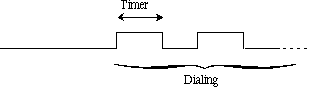
NDDI-Loop feeding dig.brk t.
BOARD PARAMETER
The adjustment is made in ms
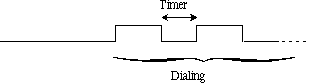
NDDI-Time Between Digits Send
This time-out gives the delay between each transmitted digit.
The adjustment is made by number of units of 100 ms.
NDDI-Timer Between Digits
Time-out after which:
dialing with user completion: the dialing is transmitted,dialing without user completion: the communication is cut off.
The adjustment is made by number of units of 100 ms.
NDDI-Default Transmission
YES: external dialing is transmitted after the Timer for default transmission (see below).
NO: external dialing is transmitted as soon as the dial tone (trunk group seizure tone, national and international intermediary tones); if there is not tone, the system releases the trunk and seize another. In case there is not tone, Timer for waiting for sending tone is taken into account (see below).
NDDI Def Trans Or Waiting Timer
When this time-out is over, the dial tone is transmitted.
- If NDID default transmission=Yes
NDID Default transmission:
When this time-out is over, digits are transmitted.
The adjustment is made by number of units of 100 ms.
NDDI Time For Availability
Time-out for availability after an outgoing call is released (is used to privilege incoming calls).
The adjustment is made by number of units of 100 ms.
NDDI Off hook-presumpt.Time
This time-out must be managed if the remote system does not carry out battery inversion or charging signal reception.
When this time-out is over, the outgoing communication changes into "conversation" state which allows services to be taken into account (enquiry call, transfer, conference, dialing transparency and possible meter pulses.The adjustment is made by number of units of 100 ms.
NOTE:
No feature (enquiry call, etc.) is available during this period.
ICNS Trunks
Used if the trunk is of type ICNS (PABX 5620)
Timer T303
The timers T303, T305, T308, T316, T399 are used to receive and transmit the different messages.
The adjustment is made by number of units of 100 ms.
Timer T305
The timers T303, T305, T308, T316, T399 are used to receive and transmit the different messages.
The adjustment is made by number of units of 100 ms.
Timer T308
The timers T303, T305, T308, T316, T399 are used to receive and transmit the different messages.
The adjustment is made by number of units of 100 ms.
Timer T316
The timers T303, T305, T308, T316, T399 are used to receive and transmit the different messages.
The adjustment is made by number of units of 100 ms.
Timer T399
The timers T303, T305, T308, T316, T399 are used to receive and transmit the different messages.
The adjustment is made by number of units of 100 ms.
MF CGCT Tie line Trunks
Used if the trunk type is MFCGCT.
Wait Proceed To Send Timer
On outgoing, after the seizure signal has been transmitted: duration of waiting for the reception of the ready to receive MF signal after which the access code is transmitted.
The adjustment is made by number of units of 100 ms.
Wait bef.sending acc.code
For outgoing calls, this is the delay before the a1 access code MF signal is transmitted.
The adjustment is made by number of units of 100 ms.
0 means no timer (on the contrary of the other timers for which 0 means infinite).
Interdigit Timer on Sending
For outgoing calls, this time-out programs the delay between each digit transmitted
The adjustment is made by number of units of 100 ms.
0 means no timer (on the contrary of the other timers for which 0 means infinite).
Wait for Back Signal Timer
On outgoing, time during which the reception of a backward MF signal is waited.
The adjustment is made by number of units of 100 ms.
Wait for Called Answer Timer
On outgoing, when the timer is exceeded and the remote terminal does not answer, it changes into conversation.
The adjustment is made by number of units of 100 ms.
0 means no timer (on the contrary of the other timers for which 0 means infinite).
Unavailable T.Betw.2 Seizes
In order to allow for incoming call priority, it is indispensable to impose a time-out between a trunk release and the next outgoing seizure.
The adjustment is made by number of units of 100 ms.
Received Nr Broadcasting
This section is used for the rerouting of the calls, in the case of a call in transit.
YES: the retransmission of the number received to reroute a call is used.
Wait bef.send.Proc.To Send
On incoming, the expiry of this timer causes the DTMF dial tone to be transmitted.
The adjustment is made by number of units of 100 ms
0 means no timer (on the contrary of the other timers for which 0 means infinite).
Wait for Forward Signal Time
On incoming, time during which the reception of a forward MF signal is waited.
The adjustment is made by number of units of 100 ms.
Delay Between Digits on Receiving
For incoming calls, this time-out programs the delay between each digit received
The adjustment is made by number of units of 100 ms.
Back Signal Sending Delay
For incoming calls, this time-out programs the delay between each backward DTMF signal.
The adjustment is made by number of units of 100 ms
0 means no timer (on the contrary of the other timers for which 0 means infinite).
Wait for Cd Release Timer
On incoming, after the called party has hung up: time during which the caller waits for the release.
The adjustment is made by number of units of 100 ms.
Wait bef.send.Contr.Freq.
Delay between the reception of a backward or forward DTMF signal and the FC transmission.
The adjustment is made by number of units of 100 ms
0 means no timer (on the contrary of the other timers for which 0 means infinite).
Max.Sequence Duration
On outgoing or incoming, maximum duration of a forward or backward slave sequence.
The adjustment is made by number of units of 100 ms.
Signal uphold Delay
The reception of a backward or forward MF signal acknowledgement is delayed in relation to the time when the transmission of the backward or forward MF signal has stopped.
The adjustment is made by number of units of 100 ms.
0 means no timer (on the contrary of the other timers for which 0 means infinite).
5200 Trunks
T303
Collision set-up timer
T308
Release Acknowledge Timer
Outgoing R1.5 Trunk
MF R1.5 signaling or Rotary signaling.
Used if the trunk type is Outgoing R1.5.
Type of dialling
The choice is made in a menu :
- D50_50 (Decimal 50-50)
- MF R1 (R1 frequencies)
Interface Type NDDI R1.5
The choice is made in a menu:
Unilateral local (validation of the calling party)Bilateral local (validation of the called party)
Wait for Seizure Ack.Timer
Maximum duration the system waits for the acknowledgement of a seizure. When this timer expires, a release occurs and another attempt is made on another trunk.
The adjustment is made by number of units of 100 ms.
1st default dialling em.
YES: optional tone detection before transmission of the beginning of dialing.
NO: obligatory tone detection before transmission of the beginni of dialing
1st Default dial.Em.Delay
If the attribute "First default transmission" is set to YES, the dialing is sent to trunk seizure when this timer expires.
The adjustment is made by number of units of 100 ms.
2nd default dialling em.
YES: optional second tone detection before transmission of the continuation of dialing.
NO: obligatory second tone detection before transmission of the continuation of dialing.
2nd Default dial.Em.Delay
If the attribute "Second default transmission" is set to YES: the second part of the dialing is sent when this timer expires.
The adjustment is made by number of units of 100 ms.
Timer End Of Dialing
If dialing is not transmitted any longer, it is considered as completed when this timer expires ; any new number will then be ignored.
The adjustment is made by number of units of 100 ms.
Timer Wait for Cd Answer
For outgoing calls, duration the system waits for the reception of an answer before it switches into conversation.
When the caller ends his dialing, this timer supervises the time when the called party answer is waited
If the called party has not answered before this timer expires, the call is released.
The adjustment is made by number of units of 1s.
PABX Call No.
The digits indicated in this section will be sent to the exchange in order to identify the caller (ANI-Automatic Number Identification). This number normally corresponds to the public number of the system (in general, that of the attendant). The DID additional digits of the caller replace the last digits.
Fill Digit For Caller Id.
Unused
This attribute indicates the number of digits (0,1 or 2) to be entered for the PCX Call number to be completed. It can contain a maximum of 7 digits as defined for the caller's identity in Russia and CIS.
Deft Category for Caller Ident.
Caller's category sent together with the caller's identity (ANI-see the attribute PCX Call number).
Special Tones Receiving
If the called party is inaccessible:
YES: the protocol orders the remote system to send a special tone to the caller or voice guide indicating that the called number cannot be reached due to congestion, inacessibility or busy set.
NO: the protocol releases the call ; the local voice guide (see the following attributes) is then used and signals that the called number cannot be reached due to congestion, inaccessibility or busy set
VG For Called Party Busy
If "special tones received" is set to NO, this voice guide is connected to the local caller in the case where the called party is inaccessible.
(for details about the voice guide number, see the chapter INSTALLATION - Voice guides).
Congestion Voice Guide
If "Special tones received" is set to NO, this voice guide is connected to the local caller in the case where the remote network is congested.
(for details about the voice guide number, see the chapter INSTALLATION - Voice guides).
Dec.Digit Pulse Duration
BOARD PARAMETER ________________________________________________________
| |Wire a |Wire b |
|________________________________________________________|
|Seizure status |- |+ |
|(between digits) | | |
|________________________________________________________|
|Signal |+ |- |
|________________________________________________________|
|Pause |Open |Open |
|________________________________________________________|
_________________________________________________________
| |Bit a |bit b |
|________________________________________________________|
|Seizure status |1 |0 |
|(between digits) | | |
|________________________________________________________|
|Signal |0 |0 |
|________________________________________________________|
|Pause |1 |0 |
|________________________________________________________|
The adjustment is made by number of units of 1ms.
Dec.Digit Pause Duration
BOARD PARAMETER ________________________________________________________
| |Wire a |Wire b |
|________________________________________________________|
|Seizure status |- |+ |
|(between digits) | | |
|________________________________________________________|
|Signal |+ |- |
|________________________________________________________|
|Pause |Open |Open |
|________________________________________________________|
_________________________________________________________
| |Bit a |bit b |
|________________________________________________________|
|Seizure status |1 |0 |
|(between digits) | | |
|________________________________________________________|
|Signal |0 |0 |
|________________________________________________________|
|Pause |1 |0 |
|________________________________________________________|
The adjustment is made by number of units of 1ms.
Interdigit Timer on Sending
This timer programs the minimum Delay between 2 consecutive digits in decadic dialling.
The adjustment is made by number of units of 100ms..
R1.5 Pulse Em.Delay
Used if the type of dialing is MF R1.
Delay between the detection of R1.5 signal and transmission of the corresponding signal.
The adjustment is made by number of units of 1ms.
R1.5 pulse duration
Used if the type of dialing is MF R1.
Signal duration of 1.5 signal pulse.
The adjustment is made by number of units of 1ms.
R1.5 Pulse Detect Delay
Used if the type of dialing is MF R1.
Delay between signal transmission and correspunding signal detection. (The aim is to avoid the reception of the echo of one's own signal).
The adjustment is made by number of units of 1ms.
R1.5 Puls.Max.Valid.time
Used if the type of dialing is MF R1.
If the signals exceed this timer, the congestion protocol is sent.
The adjustment is made by number of units of 1ms.
Timer Wait For R1.5 Pulse
Used if the type of dialing is MF R1.
Each time a R1.5 signal is transmitted, this timer supervises the receipt of the corresponding forward R1.5 signal.
The adjustment is made by number of units of 1ms.
Line Type
BOARD PARAMETER
This attribute makes it possible to adapt the electrical gain of the outgoing line:
Short line: gain decreaseLong line: gain increase...
MF R1 Level
This attribute makes it possible to adapt the level to the different MF R1 frequencies (High level/low level).
Trunk Signaling Type
This attribute makes it possible to adapt the type of signaling for PCM interface:
Normal bitsInverted bits
Incoming R1.5 Trunk
Used if the trunk type is Incoming R1.5.
MF R1.5 signaling or Rotary signaling.
Type of dialling
The choice is made in a menu:
- D50_50 (Decimal 50-50).
- MF R1 (R1 frequencies).
Interface Type DDI R1.5
The choice is made in a menu:
Local (Interface for incoming calls from local exchange)Toll (Interface for incoming calls from toll exchange).
Dial Tone Connection
YES: transmission of dial tone to the remote party.
Number of Digits Received
The number of digits received is the number of digits supplied by the public network for direct selection on arrival.
Number of Digits Used
The number of digits in local directory may be different from the the Number of digits received. This is the number of digits needed by the system to select the set.
The number of useful digits may be 1 to 8 digits long.
Example
Range of DID numbers provided by the public network : 4300 to 4399 / local hundredth : 300 to 399.
local hundredth corresponds to the hundredth of the public network (no transcoding).Number of digits received = 4Number of digits used = 3This parameter is not used if there is no translation (see TRUNK GROUPS - DID transcoding).
Caller Identification
The choice is made in a menu:
requestedNot requested
Requested : Indicates if the PABX is going to begin the sequence for calling party identification after receiving the called party number.
VG on Busy Cd party
Voice guide connected to the caller if the called is busy.
(see Voice guides)
VG on Inacc.Cd party
Voice guide connected to the caller if the called is inaccessible.
Congestion Voice Guide
Voice guide connected to the caller in the case of congestion.
Max.Dec.Digit Pulse Dur.
BOARD PARAMETER
3 wires: ________________________________________________________
| |Wire a |Wire b |
|________________________________________________________|
|Seizure status |- |+ |
|(between digits) | | |
|________________________________________________________|
|Signal |+ |- |
|________________________________________________________|
|Pause |Open |Open |
|________________________________________________________|
_________________________________________________________
| |Bit a |bit b |
|________________________________________________________|
|Seizure status |1 |0 |
|(between digits) | | |
|________________________________________________________|
|Signal |0 |0 |
|________________________________________________________|
|Pause |1 |0 |
|________________________________________________________|
The adjustment is made by number of units of 1ms.
Max.Dec.Digit Pause Dur.
BOARD PARAMETER
3 wires: ________________________________________________________
| |Wire a |Wire b |
|________________________________________________________|
|Seizure status |- |+ |
|(between digits) | | |
|________________________________________________________|
|Signal |+ |- |
|________________________________________________________|
|Pause |Open |Open |
|________________________________________________________|
_________________________________________________________
| |Bit a |bit b |
|________________________________________________________|
|Seizure status |1 |0 |
|(between digits) | | |
|________________________________________________________|
|Signal |0 |0 |
|________________________________________________________|
|Pause |1 |0 |
|________________________________________________________|
The adjustment is made by number of units of 1ms.
Delay Between Digits on Receiving
Maximum time-out for waiting for the digits after the signal of confirmation of seizure or of waiting time between two consecutive digits is emitted.
At the end of this time-out, the call is released and a message of fault is displayed.
The adjustment is made by number of units of 100ms.
R1.5 Pulse Em.Delay
Used if the type of dialing is MF R1.
Delay between the detection of R1.5 signal and transmission of the corresponding signal.
The adjustment is made by number of units of 1ms.
R1.5 pulse duration
Used if the type of dialing is MF R1.
Signal duration of 1.5 signal pulse.
The adjustment is made by number of units of 1ms.
R1.5 Pulse Detect Delay
Used if the type of dialing is MF R1.
Delay between signal transmission and correspunding signal detection. (The aim is to avoid the reception of the echo of one's own signal).
The adjustment is made by number of units of 1ms.
R1.5 Puls.Max.Valid.time
Used if the type of dialing is MF R1.
If the signals exceed this timer, the congestion protocol is sent.
The adjustment is made by number of units of 1ms.
Timer Wait For R1.5 Pulse
Used if the type of dialing is MF R1.
Each time a R1.5 signal is transmitted, this timer supervises the receipt of the corresponding forward R1.5 signal.
The adjustment is made by number of units of 1ms.
Line Type
This attribute makes it possible to adapt the electrical gain of the outgoing line:
Short line: gain decreaseLong line: gain increase
MF R1 Level
This attribute makes it possible to adapt the level to the different MF R1 frequencies (High level/low level).
Trunk Signaling Type
This attribute makes it possible to adapt the type of signaling for PCM interface:
Normal BitsInverted bits
R1.5 First Signal
Not informed
Mixed Trunk
Used if the trunk type is combination.
Line Signalling
BOARD PARAMETER
You must choose from the menu:
- Signaling by default
- PCM Q421
- PCM Pulsed on bit a
- PCM Pulsed on bit b
- ...
Exchange Type
You must choose from the menu:
W48 (Austria)W48U (Austria)OES (Austria)PCM connected to a remote Analog exchange (Czech Republic)PCM connected to a remote Digital exchange
Line Type
BOARD PARAMETER
This section makes it possible to adapt the electrical gain of the out-going line
Short Line: gain decreaseLong Line: gain increaseMedium line (Central Europe)Standard gain (Central Europe)Standard gain=standard value in the country concerned.
2 or 4 Voice Wires
BOARD PARAMETER
Attribute used by EMTL/ACEM boards.
You must choose from the menu:
2 - wire: the link is private type a, b for the voice4 - wire: the link is private type a, b, c, d for the voice
Short Pulse Duration (x10ms)
BOARD PARAMETERS
This timer defines the duration of the short pulses emitted by the coupler (seizure, seizure acknowledgement, etc.).
Long Pulse Duration (x10ms)
BOARD PARAMETERS
This timer defines the duration of the long pulses emitted by the coupler (on-hooking, release).
Outgoing Mixed Trunk
Used if the trunk type is combination.
Outgoing Seizure Acknowledgment
Choice by a menu:
- NO: the outgoing trunk does not expect a seizure acknowledgement signal. When the seizure acknowledgement timeout expires, the first digit of the called number can be transmitted by the trunk.
- YES: the outgoing trunk expects a seizure acknowledgement signal of the remote trunk up to the expiration of the seizure acknowledgement timeout. If the seizure acknowledgement signal is not received, the outgoing trunk is released.
- One pulse
- Two pulses
- One state change
- Two state changes
The selection of one of these values depends on the protocol used; the outgoing trunk expects a seizure acknowledgement signal of the selected form.
The default and preferred selection is YES.
Seizure Acknowledgment Timer
See the Outgoing Seizure Acknowledgment attribute.
The value is incremented by steps of 100 ms.
Dial Tone Detection
YES: an invitation to transmit tone is expected from the remote exchange before the dialing is sent.
Default Transmission
YES: The external dialing is transmitted as soon as the tone is detected or after the default transmission time.
NO: The external dialing is transmitted as soon as the tone is detected by the DSP (trunk group seizure tone, intermediary national and international tones) the system releases the trunk and takes another.
Default Transmission Delay
See the attribute 'default transmission'
The adjustment is made by number of units of 100 ms.
Type of Numbering
The choice is made from a menu:
D66_33 (Decimal 66-33)D50_50 (Decimal 50-50)DTMFQ23
Digit Pulse Duration (ms)
BOARD PARAMETER
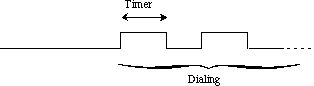
The adjustment is made by ms.
Digit Pause Duration (ms)
BOARD PARAMETER
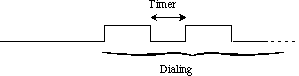
The adjustment is made by ms.
Interdigit Timer on Sending
This time-out gives the delay between each transmitted digit.
The adjustment is made by number of units of 100 ms.
Wait for Called Party Answer
YES : the trunk waits for the answer signal before changing into speech state (without answer, the call is cut at the end of the time-out "Waiting for the called party answer timer").
NO : the trunk changes over conversation state at the end of the "Waiting for the called party answer timer" if the answer signal has not been detected
Wait for Called Answer Timer
See the attribute Waiting For the Called Party Answer
The adjustment is made by units of 100 ms.
Release Method
BOARD PARAMETER
Non-compelled Control: the first person who on-hooks releases the call.Calling Party Control: the called party can go on-hook and then off-hook (before the end of the Delay Waiting Called Party Re Answer), without ending the call, he remains connected with the calling party (if the calling party has not in fact on-hooked). Each time the called party goes on-hook, the Delay Waiting Called Party Re Answer is started.Called Party Control: the calling party can go on-hook and then off-hook without ending the call, he remains connected with the called party (if the called party has not in fact on-hooked).
There is no timer in this case (only Q421 type 2 line signaling)
according to the R2 signaling table: the release method is defined in the R2 SIGNALING TRANSLATION table according to the external number dialled.Release on 1st pulse: in pulse signaling, the 1st end which releases emits a pulse which returns the trunks to idle.
Wait for Called Re-Answer Timer
See the attribute Release method
The adjustment is made by number of units of 10 ms.
Unavailable Time Betw.2 Seizes
BOARD PARAMETER
Unavailability time-out between trunk release and the next incoming call (makes it possible to give greater importance to outgoing calls).
The adjustment is made by number of units of 10 ms.
Incoming Mixed Trunk
Used if the trunk type is combination.
Incoming Seizure Acknowledgment
Choice by a menu:
- NO: the incoming trunk does not transmit a seizure acknowledgement signal.
- YES: the incoming trunk transmits a seizure acknowledgement signal to the remote trunk when the seizure acknowledgement transmission timeout expires.
- One pulse
- Two pulses
- One state change
- Two state changes
The selection of one of these values depends on the protocol used; the incoming trunk transmits a seizure acknowledgement signal of the selected form.
The default and preferred selection is YES.
Delay Before Sending Seizure Ack
See the Incoming Seizure Acknowledgment attribute.
If the timeout is equal to 0, the seizure acknowledgement is transmitted immediately after the seizure signal is detected.
The value is incremented by steps of 100 ms.
Dial Tone Connection
YES: invitation to transmit tone sent to the remote exchange.
Number of Digits Received
The Number of digits received (between 1 and 8) is the number of digits provided by the public network for the direct incoming dialing.
If this parameter is equal to:
0, the DID is used in open dialing mode. In this case, DID transcoding cannot be used (see TRUNK GROUP - DID transcoding).1, 2 or more than 4, the DID is used in closed dialing mode. In this case, DID transcoding cannot be used.3 or 4 (classic cases) the DID is used in closed dialing mode and transcoding can be used.
Number of Digits Used
The number of digits in local directory may be different from the the Number of digits received. This is the number of digits needed by the system to select the set.
The number of useful digits may be 1 to 8 digits long.
Example
Range of DID numbers provided by the public network : 4300 to 4399 / local hundredth : 300 to 399.
local hundredth corresponds to the hundredth of the public network (no transcoding).Number of digits received = 4Number of digits used = 3This parameter is not used if there is no translation (see TRUNK GROUPS - DID transcoding).
Incoming DTMF Received
YES: reception of Q23 multi-frequencies.
Delay Between Digits on Receiving
This time-out programs the delay between each digit in reception mode or the waiting time between 2 consecutive digits.
If this timer is needed in:
closed dialing : the communication is released and a fault message is issuedopen dialing :the communication overflows to the routing table.
The adjustment is made by number of units of 100 ms.
First Digit Authorized
If the first digit of the DID number received is not authorized, the communication is interrupted.
Routing to Attendant
In open dialing, if the first digit received corresponds to the one chosen for this parameter (0 to 9), there is immediate forwarding to the routing table without waiting for the reception of the other digits.
Open Dialling
YES: sections Number of digits received is equal to 0.
End of Selection
Choice by a menu:
NO: the incoming trunk does not transmit the end of selection signal.YES: the incoming trunk transmits the end of selection signal; the same signal is transmitted, whatever the called is free or busy.Free / Busy: the incoming trunk transmits the end of selection signal; a different signal is transmitted, whether the called is free or busy.
Send Called Party Answer
YES: response signal sent when the called party off-hooks.
Release Method
BOARD PARAMETER
Non-compelled Control: the first person who on-hooks releases the call.Calling Party Control: the called party can go on-hook and then off-hook (before the end of the Delay Waiting Called Party Re Answer), without ending the call, he remains connected with the calling party (if the calling party has not in fact on-hooked). Each time the called party goes on-hook, the Delay Waiting Called Party Re Answer is started.Called Party Control: the calling party can go on-hook and then off-hook without ending the call, he remains connected with the called party (if the called party has not in fact on-hooked).
There is no timer in this case (Q421 type 2 line signaling only)
According to the R2 signaling table, the release method is defined in the China DID R2 Group II signals signaling table.Release on 1st pulse: in pulse signaling, the 1st end which releases emits a pulse which returns the trunks to idle.
Wait for Called Re-Answer Timer
If the calling party does not go on-hook, this time-out makes it possible to control the time during which the system waits for the called party goes off-hook again before releasing the call if the attribute Release method" is on Called Party Control (See the attribute Release method")..
The adjustment is made by number of units of 100 ms.
Trunk MF R1.5
Used if the trunk type is MF R1.5.
Type of dialling
The choice is made in a menu :
- D50_50 (Decimal 50-50)
- MF R1 (R1 frequencies).
Interface Type MF R1.5
The choice is made in a menu:
LocalBilateral localCharged
Wait for Seizure Ack.Timer
Maximum duration the system waits for the acknowledgement of a seizure. When this timer expires, a release occurs and another attempt is made on another trunk.
The adjustment is made by number of units of 100 ms.
1st default dialling em.
YES: optional tone detection before transmission of the beginning of dialing.
NO: obligatory tone detection before transmission of the beginning of dialing.
1st Default dial.Em.Delay
If the attribute "First default transmission" is set to YES, the dialing is sent to trunk seizure when this timer expires.
The adjustment is made by number of units of 100 ms.
2nd default dialling em.
YES: optional second tone detection before transmission of the continuation of dialing.
NO: obligatory second tone detection before transmission of the continuation of dialing.
2nd Default dial.Em.Delay
If the attribute "Second default transmission" is set to YES: the second part of the dialing is sent when this timer expires.
The adjustment is made by number of units of 100 ms.
Timer End Of Dialing
If dialing is not transmitted any longer, it is considered as completed when this timer expires ; any new number will then be ignored.
The adjustment is made by number of units of 100 ms.
Timer Wait for Cd Answer
For outgoing calls, duration the system waits for the reception of an answer before it switches into conversation.
When the caller ends his dialing, this timer supervises the time when the called party answer is waited
If the called party has not answered before this timer expires, the call is released.
The adjustment is made by number of units of 1s.
PABX Call No.
The digits indicated in this section will be sent to the exchange in order to identify the caller (ANI-Automatic Number Identification). This number normally corresponds to the public number of the system (in general, that of the attendant). The DID additional digits of the caller replace the last digits.
Fill Digit For Caller Id.
Unused
This attribute indicates the number of digits (0,1 or 2) to be entered for the PCX Call number to be completed. It can contain a maximum of 7 digits as defined for the caller's identity in Russia and CIS.
Deft Category for Caller Ident.
Caller's COS sent together with the caller's identity (ANI-see the attribute PCX Call number).
Special Tones Receiving
If the called party is inaccessible:
YES: the protocol orders the remote system to send a special tone to the caller or voice guide indicating that the called number cannot be reached due to congestion, inacessibility or busy set.
NO: the protocol releases the call ; the local voice guide (see the following attributes) is then used and signals that the called number cannot be reached due to congestion, inaccessibility or busy set.
Dial Tone Connection
YES: transmission of dial tone to the remote party.
Number of Digits Received
The number of digits received is the number of digits supplied by the public network for direct selection on arrival.
Number of Digits Used
The number of digits in local directory may be different from the the Number of digits received. This is the number of digits needed by the system to select the set.
The number of useful digits may be 1 to 8 digits long.
Example
Range of DID numbers provided by the public network : 4300 to 4399 / local hundredth : 300 to 399.
local hundredth corresponds to the hundredth of the public network (no transcoding).Number of digits received = 4Number of digits used = 3
Caller Identification
YES: Indicates if the PABX is going to begin the sequence for calling party identification after receiving the called party number.
VG on Busy Cd party
Voice guide connected to the caller if the called is busy.
VG on Inacc.Cd party
Voice guide connected to the caller if the called is inaccessible.
Congestion Voice Guide
Voice guide connected to the caller in the case of congestion.
Dec.Digit Pulse Duration
BOARD PARAMETER
3 wires: ________________________________________________________
| |Wire a |Wire b |
|________________________________________________________|
|Seizure status |- |+ |
|(between digits) | | |
|________________________________________________________|
|Signal |+ |- |
|________________________________________________________|
|Pause |Open |Open |
|________________________________________________________|
________________________________________________________
| |Bit a |bit b |
|________________________________________________________|
|Seizure status |1 |0 |
|(between digits) | | |
|________________________________________________________|
|Signal |0 |0 |
|________________________________________________________|
|Pause |1 |0 |
|________________________________________________________|
The adjustment is made by number of units of 1ms.
Dec.Digit Pause Duration
BOARD PARAMETER
3 wires: ________________________________________________________
| |Wire a |Wire b |
|________________________________________________________|
|Seizure status |- |+ |
|(between digits) | | |
|________________________________________________________|
|Signal |+ |- |
|________________________________________________________|
|Pause |Open |Open |
|________________________________________________________|
________________________________________________________
| |Bit a |bit b |
|________________________________________________________|
|Seizure status |1 |0 |
|(between digits) | | |
|________________________________________________________|
|Signal |0 |0 |
|________________________________________________________|
|Pause |1 |0 |
|________________________________________________________|
    ________________________________________________________
   |                           |Wire a        |Wire b       |
   |________________________________________________________|
   |Seizure status             |-             |+            |
   |(between digits)           |              |             |
   |________________________________________________________|
   |Signal                     |+             |-            |
   |________________________________________________________|
   |Pause                      |Open          |Open         |
   |________________________________________________________|
________________________________________________________
| |Bit a |bit b |
|________________________________________________________|
|Seizure status |1 |0 |
|(between digits) | | |
|________________________________________________________|
|Signal |0 |0 |
|________________________________________________________|
|Pause |1 |0 |
|________________________________________________________|
    ________________________________________________________
   |                           |Wire a        |Wire b       |
   |________________________________________________________|
   |Seizure status             |-             |+            |
   |(between digits)           |              |             |
   |________________________________________________________|
   |Signal                     |+             |-            |
   |________________________________________________________|
   |Pause                      |Open          |Open         |
   |________________________________________________________|
    ________________________________________________________
   |                           |Bit a         |bit b        |
   |________________________________________________________|
   |Seizure status             |1             |0            |
   |(between digits)           |              |             |
   |________________________________________________________|
   |Signal                     |0             |0            |
   |________________________________________________________|
   |Pause                      |1             |0            |
   |________________________________________________________|
The adjustment is made by number of units of 1ms.
Interdigit Timer on Sending
Delay Between Digits on Receiving
R1.5 Pulse Em.Delay
Used if the type of dialing is MF R1.
Delay between the detection of R1.5 signal and transmission of the corresponding signal.
The adjustment is made by number of units of 1ms.
R1.5 pulse duration
Used if the type of dialing is MF R1.
Signal duration of 1.5 signal pulse.
The adjustment is made by number of units of 1ms.
R1.5 Pulse Detect Delay
Used if the type of dialing is MF R1.
If the signals exceed this timer, the congestion protocol is sent.
The adjustment is made by number of units of 1ms.
R1.5 Puls.Max.Valid.time
Timer Wait For R1.5 Pulse
Used if the type of dialing is MF R1.
Each time a R1.5 signal is transmitted, this timer supervises the receipt of the corresponding forward R1.5 signal.
The adjustment is made by number of units of 1ms.
Line Type
BOARD PARAMETER
To be used by specialists only.
This attribute makes it possible to adapt the electrical gain of the line
Short line: adjustment to suit short line low gain,Long line: adjustment to suit long line high gain,line 1: balancing adaptation for very short lines low gainline 2: balancing adaptation for short lines low gainline 3: balancing adaptation for medium 0.4mm type lines high gainline 4: balancing adaptation for medium 0.5 or 0.6mm type lines high gainline 5: balancing adaptation for long 0.4 mm type lines high gainline 6: balancing adaptation for medium 0.5 or 0.6mm type lines high gainline 7: reservedline 8: reserved
WARNING :
The choice is fixed according to the country chosen for the board (see BOARDS object). Any modifications are to be carried out under Alcatel-Lucent control.
MF R1 Level
This attribute makes it possible to adapt the level to the different MF R1 frequencies (High level/low level).
Trunk Signaling Type
This attribute makes it possible to adapt the type of signaling for PCM interface:
Normal bitsInverted bits
R1.5 First Signal
Not informed
Priorities
Category of the trunk to be used for the BEMILCOM project on R2 trunks.
It indicates whether the R2 trunks use a particular signaling to send a priority notion.
R2 signaling: Outgoing call on R2 with priority.
(See priority service or MLPP service).
Routine frequency
R2 outgoing calls with the "routine" priority use the "routine" frequency according to their defined priority.
Prioritary call frequency
R2 outgoing calls with the "prioritary" priority use the "prioritary" frequency according to their defined priority.
Protected call frequency
R2 outgoing calls with the "protected" priority use the "protected" frequency according to their defined priority.
Routine call priority level
An R2 incoming call uses a frequency corresponding to a priority:
BEMILCOM priority -> routine
Equivalent MLPP priority -> activation mode A=0 N1: Level defined in the trunk category.
Protected call level
An R2 incoming call uses a frequency corresponding to a priority:
BEMILCOM priority -> protected
Equivalent MLPP priority -> activation mode A=1 N2: Level defined in the trunk category
Priority call level
An R2 incoming call uses a frequency corresponding to a priority:
BEMILCOM priority -> priority
Equivalent MLPP priority -> activation mode A=3 N3: Level defined in the trunk category
Voice pipe trunk
Used if the trunk type is Voice TL Trunk.
2 or 4 Voice Wires
BOARD PARAMETER
Possible choices :
- 2 - wire: the link is private type a, b for voice
- 4 - wire: the link is private type a, b, c, d for voice
2280 BEMILCOM TL Trunks
Used if the trunk type is 2280 BEMILCOM TL Trunk..
Send Reply
YES: sends the signal of answer when the called party goes off-hook (if taken into account by the remote terminal).
Receiving the Dialling
YES: the circuit is used as automatic tie-line.
NO: the circuit is used as manual tie line.
Delay Waiting for Reply
Time-out after which the change over conversation is performed if the remote terminal does not transmit any answer signal. The network-to-network transfer is impossible if value = 0-0.
The adjustment is made by number of units of 100 ms.
Delay Between Digits on Sending
This time-out programs the delay between each digit transmitted.
The adjustment is made by number of units of 100 ms.
Delay Before Outdialling
Time-out which makes it possible to delay the transmission of the first digit after receiving the proceed to send signal. It also makes it possible to transmit by default the status code Tie line.
The adjustment is made by number of units of 100 ms.
Reply by Pulse
YES: signal sent as a pulse.
Controlled Release
YES : the trunk is released after the signal for remote terminal release is received.
Dial Tone Detection
YES: an invitation to transmit tone is expected from the remote before the dialing is emitted.
Default Transmission
Outgoing dialing is transmitted as soon as the tone is detected by DTON (trunk seizure tone, intermediary national and international tones).
YES: If there is no tone, outgoing dialing is transmitted after the default transmission time-out.
NO: If there is no tone, the system releases the trunk and takes another.
Busy Tone Connection
YES: the busy tone is transmitted to the remote user (for example a wrong number has been dialed or the station is busy).
Seizure Pulse Time
Seizure pulse transmission time.
The adjustment is made by number of units of 8 ms.
Answer Pulse Time
Answer pulse transmission time.
The adjustment is made by number of units of 8 ms.
Release Pulse Time
Release pulse transmission time.
The adjustment is made by number of units of 8 ms.
Radio channel trunk
Used if the trunk type is Radio channel trunk.
2 or 4 Voice Wires
BOARD PARAMETER
Possible choices :
- 2 - wire: the link is private type a, b for voice
- 4 - wire: the link is private type a, b, c, d for voice
Multi channel
YES: the radio system connected behind the radio trunk authorizes frequency selection. This selection is made in the DTMF frequency band (Q23)
The maximum number of digits for frequency selection is given by the number of digits to be sent in the data for the IA trunk group to which the trunk belongs. The maximum number of digits authorized for the frequency selection is 4. (See LIA type TRUNK GROUP, attribute Number of digits to send). ***
PTT DTMF
Attribute reserved
YES: the PushToTalk signal must be in the frequency band
Incoming DTMF Received
YES: in DTMF dialing, search for a DTMF receiver before transmission of the seizure confirmation signal.
Wait for Reply Timer
Time-out after which the change over conversation is performed if the remote terminal does not transmit an answer signal. The network-to-network transfer is impossible if value = 0.
The adjustment is made by number of units of 100 ms.
Automatical reconfiguration