NUMBERING PLAN DESCRIPTION (NPD)
The NUMBERING PLAN DESCRIPTION (NPD) describes how to translate the numbers received from the external network and how to build the numbers called to this external network.
Description identifier
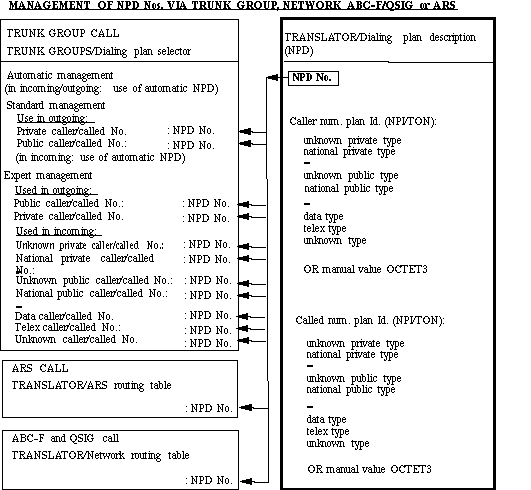
The NUMBERING PLAN DESCRIPTION No. is used to identify the Descriptor. It is used in management by the TRUNK GROUPS (TRUNK GROUP DIALING PLAN SELECTOR), and by the ARS ROUTE LISTS and THE NETWORK ROUTING TABLES.
Name
Free name enabling the manager to identify the Descriptor.
Calling Numbering plan ident.
Value to be set for incoming and outgoing calls depending on the carrier the trunk group is connected on and depending on the subscription:
Standardized values:
- Unknown
- Data
- NPI/TON: Telex
- .....
Manual value
In the latter case, byte 3 must be managed manually - see the next attribute Calling party num. I.E. Byte3 val.
Calling party num. I.E. Byte3 val
Number of the byte 3 to be defined if the attribute Calling numbering plan identification (NPI) is managed on ."NPI/TON user defined"
Byte 3 of the ISDN protocol is a set of attributes describing how to build the called party byte 3s (see BYTE 3 in INSTALLATION).
Called numbering plan ident.
Value to be set for incoming and outgoing calls depending on the carrier the trunk group is connected on and depending on the subscription:
Standardized values:
- Unknown
- Data
- NPI/TON: Telex
- .....
Manual value
In the latter case, byte 3 must be managed manually - see the next attribute Called party num. I.E. Byte3 val.
Called party num. I.E. Byte3 val
Number of the byte 3 to be defined if the attribute Called numbering plan identification (NPI) is managed on ."NPI/TON user defined"
Byte 3 of the ISDN protocol is a set of attributes describing how to build the called party byte 3s (see BYTE 3 in INSTALLATION).
Authorize personal calling num use
Yes: For an outgoing call, calling number is the personal calling number configured in user data (if the user is configured)
No: personal calling number is not used (the reverse DID translator is used)
Warning : when NPD descriptor is used for emergency call (911,112..), thisparameter must set to NO.
Install. number source
Choice of the installation number to be added to the user's directory number to obtain the complete ISDN No. (installation No. + additional installation No.):
- entity: the installation number is that of the user entity,
- NPD: the installation number is that defined in the attribute Installation No. (see next attribute),
- no number.
Installation number
Installation number to be added to the user's directory number to obtain the complete ISDN number.
This attribute operates in relation with the attribute Installation number source set to NPD.
Default number source
Choice of the default number to be used in case of inverse transcoding failure (E.g.: user cannot be called in DDI):
- entity: the number is that of the user entity
- NPD: the number is that defined in the attribute Default No.
- no number
Default number( num. inst. sup.)
Installation default number to be added to the user's directory number to obtain a complete ISDN number in case of failure of the inverse DDI translation.
This attribute operates in relation with the attribute Default number source set to NPD.
Called DID identifier
DDI translator number (0 to 99) to be used for called party transcoding.
Table No. 0 is the DEFAULT DDI TRANSLATOR used if multi-translation is not used.
-1 means that no incoming transcoding will be carried out. The user's directory number is used as it is.
Calling/Connected DID identifier
DDI translator number (0 to 99) to be used in outgoing for transcoding of calling parties and connected parties (remote parties answering the call).
Table No. 0 is the DEFAULT DDI TRANSLATOR used if multi-translation is not used.
-1 means that no outgoing transcoding will be carried out. The user's directory number is used as it is.