SYSTEM
This table makes it possible to define some parameters common to the whole system.
Instance (reserved)
Country
Country for signaling of external lines circuits (boards).
The attribute can be selected from the following list:
- Austria,
- Belgium,
- Denmark,
- UK
- France
- Germany
- Italy
- Portugal
- Hungary
- Poland
- Czech Republic
- Slovakia
- Norway
- Sweden
Node Number
This number indicates which node the system belongs to in a private network.
Network Number
This number indicates which network the trunk group belongs to.
Line lockout incident sending
Miscall of analog sets are level 3 fault by default (printed on-line).
YES: miscall of analog sets change into level 2 fault (Storage + on-line printing).
Display languages
These sections are used to set languages for the messages and guides which are displayed on the screen of the set (n languages from all languages set in the system (e.g.: French, English, German, Spanish, Portuguese, Flemish, Danish, Italian, Austrian).
A reference of this language is used in the previous section for display ("Users languages" attribute)
Users languages
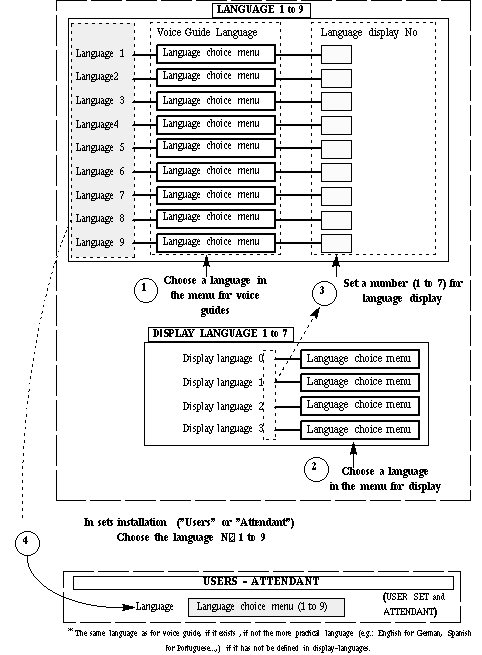
These sections make it possible to set parameters for selecting a language for voice guides and the display.
9 choices can be installed to be chosen during the installation of user sets (see language attribute in USERS SETS) and attendant sets (see language attribute in ATTENDANT).
In each of the choices 1 to 9, a language is selected for voice guides and a language for messages and guides displayed on the sets screens (It is a programming of a pair of languages identified by the nationality).
- Nationality: a language name chosen from the menu makes it possible to name the pair of languages,
- Display: digit corresponding to a language (parameters are set in next attribute "Display languages").
- Voice guides: digit from corresponding to a language installed in US interface (i.e.: French, English, German, Spanish, Portuguese, Flemish, Danish, Italian, Austrian).
WARNING :
The max. number of available languages for the digital set displays is set via ACTIS (from 4 max. (0 to 3) to 8 max. (0 to 7).
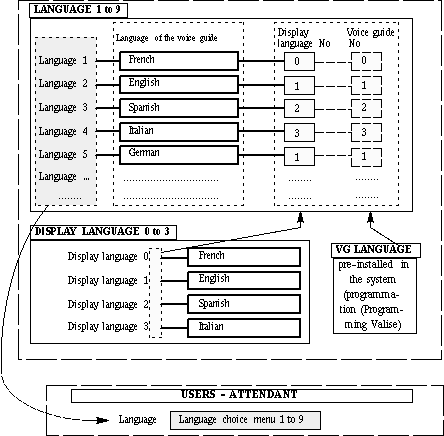
Example:
In a system programmed with 5 languages French, English, German, Spanish, Italian in voice guides and with 4 languages - French, English, German, Spanish - for display:
- An English subscriber can be installed with voice guides and display in English,
- A German subscriber can be installed with voice guides in German, but the display can be installed, for example, in English.
Language For Screen/Printout
This section makes it possible to select the language of applications (for example: internal charging).
1 language among those which are proposed by the system can be set (e.g.: French, English, German, Spanish, Portuguese, Flemish, Danish, Italian, Austrian).
X121 Area
Dialling area (0 to 12) for terminals which automatically transmit dialling.
For example, nowadays in France:
- 0 = Paris
- 1 = elsewhere in France
Client Information
These parameters are used by some of the printouts (charging report, hotel billing, etc.):
- Name (a maximum of 30 characters),
- Address (a maximum of 40 characters),
- Country (a maximum of 20 characters),
- City / Town (a maximum of 25 characters),
- Date Format (Latin(0)/Anglo-Saxon(1)).
DPNSS Parameters
(SPECIFIC FOR GREAT BRITAIN)
Master
YES: the status of PCX is master. It has the reference date and time (it corresponds to the PCX in which the administrator is located). It sends date and time to the slave PCXs.
NO: the status of PCX is slave.
ICL
Priority level of a PCX in relation to other PCX in the network regarding intrusion.
This section is operational only for users who are allowed to use the "intrusion" suffix (see the COS of telephone feature in the node).
This right can be set to 1, 2 or 3:
1 (default setting): subscriber A in the current node cannot barge into a conversation of subscriber B in progress when he calls him on another node of the network.
2: subscriber A in the current node can barge-in a conversation of a subscriber B in progress when he calls him on another node of the network.
3: attendant (this parameter does not apply to the attendants, therefore the position 3 makes it possible to recognize them).
Node Prefix
This number corresponds to the prefix of identification of the local node in relation to the remote subscriber (the subscriber uses this prefix in order to dial the directory number of a set located into this node).
Night Mode
YES: the night mode is used (the attendant is out).
Routing Optimisation
YES: the routing optimization is used.
Access Code
This code is a prefix added, in the local node, to the numbers transmitted by the remote system. It may be useful in certain cases of conflicts (the first digits of the local nodes are identical to the prefix of one of the nodes) in order to distinguish between the local nodes of the numbers transmitted by the remote system and destined to another node into the DPNSS network.
This access code must be different from the numbers used in the local numbering plans.
For the calls which are transmitted by the remote system, the access code is placed before the directory number in the DPNSS entering message.
If the call is destined to the local node, the DPNSS address is transformed into a number which corresponds to the local translator,
Otherwise, the number is transformed into a new DPNSS outgoing call; in this case the PCX is used in transit.
If the call is destined to the local node, the translator will give:ACCES CODE + NODE PREFIX + DIRECTORY No.
The access code and node prefix must be subtracted from the number before being processed by the local translator.
RAR Address
This section contains the directory number used to collect incidents.
DPNSS PABXs addresses List
The content of this list is:
- if the PCX is the master: the directory numbers (CPU addresses) of the slave PCX
- if the PCX is the slave: the directory number of its master PCX.
This list makes it possible to reach its slave PCXs in order to set the time.
Force gain adaptation
NO:
- The audio gain of the communications between UA digital sets through T0/T2 (and PCM in certain countries) digital trunks is standard.
- The gain of the communications between UA digital sets through analog trunks or between analog sets through digital trunks is adapted.
YES: the gain of all the communications is adapted.
Date/Time
Reminder of the current system date and time (not accessible)
- 4 characters for year: --yy
- 2 characters for month: mm
- 2 characters for day: dd
- 2 characters for hours: hh
- 2 characters for minutes: mn
- 2 characters for seconds: ss
Date and time can be updated by attendants.
Publ.MiniMail Subscrip.
In case the ISDN subscription is taken without the UUS service (mini-messaging), the TEXT dynamic key used to send the UUS is not operational. Consequently, it is recommended not to make it appear.
NO: to inhibit the display of the TEXT key on UA sets.
Incoming DDI overf.priv.->publ.
When a logical link or a sub-network link is out of service or saturated, the call can be redirected through a switched link to reach the recipient set.
This attribute allows to enable or disable the rerouting after an incoming DID call (to avoid the risk of loop in case of bi-directional forwarding).
The possible values are:
- 1 = No overflow enabled.
- 2 = Overflow on out of service link.
- 3 = Overflow on busy link.
- 4 = Overflow on out of service and busy link.
- 0, 5 and others = No overflow enabled.
With LLC HLC
LLC = Low Layer Capability
HLC = High Layer Capability
The information elements (EI) are sent in the message ESTABLISHMENT (setup ISDN) (Q931):
1: YES
0: NO
Max Nb Trunks Conf.N
This section makes it possible to force the maximum number of trunk groups authorized in 7 or 28-party conferences depending on the quality observed.
Erase Redialing Memory
The memory key of users' sets is used to memorize the previous call by simply pressing it, in order to later redial using the same MEMORY key:
1 = option "REMOVES MEMORY":
It functions in "Toggle on/off" (ON=memorizes/OFF=redials and removes):
- Pressing the MEMORY key puts the dialled number into memory; the icon signals that one number is in memory.
- Pressing the MEMORY key again redials the number and REMOVES the number out of the memory: the icon disappears signaling that there is no longer number in memory.
Maybe, pressing immediately the key makes it possible to keep the number back into memory.
0 = option "KEEP IN MEMORY":
Depends on the "On-line/off-line" position of the set (ON-LINE = memorizes/OFF-LINE = redials and memorizes):
- on-line: the MEMORY key puts the dialled number into memory.
- off-line: the MEMORY key sends this number and KEEPS it into memory.
The former number may be replaced by a new one only by dialling a new Number and pressing the MEMORY key, set on-line.
PIN length
Used for the personal calls (private), this code appears then in the accounting tickets and is charged to the subscriber. PIN (personal identification number) in the tickets makes it possible to identify this type of call.
The code is between 0 and 8 digits long.
- between 1 and 8 digits:
The user dials the personal identification prefix + this personal identification number (PIN) + External number;
The PIN will be written onto the accounting ticket and personal call mentioned.
- 0:
The user dials the personal identification prefix + the personal code + the external number;
Personal call will be the only indication on the accounting ticket.
- -1:
No control: the personal identification prefix is dialed + the external number;
Personal call will be the only indication on the accounting ticket.
With this method, the call is made with no barring.
Nb of ARS PIN Code Errors
The maximum time you can input wrong PIN number. The default value is three.
Transfer Private Calls
The default value is 0 which means do not transfer.
React.Receiving State Mess.
EI (Information Elements):
39 : EI_NOTI_INDI
28 : EI_FACILITY
Ignore All IPNS EI
YES: avoids the communication being cut off on reception of cause 99 or 100, whatever the EI.
Cause
99: CA_ELMT_INCONNU)
100: CA_CONT_INVALIDE
Ignore IPNS Mess. Notify/Facility
YES: avoids the communication being cut off on reception of cause 98 or 110.
Cause
98: MESS_FACILITE
110: MESS_NOTIFY
Ignore All RNIS T2 EI
YES: in the case of T2, avoids the communication being cut off on reception of cause 100 or 99.
Cause
99: CA_ELMT_INCONNU
100: CA_CONT_INVALIDE
Number Of Transit Pabx
Maximum number of PCXs a request for making a call to a given PCX is authorized to pass through.
The purpose of this section is to avoid re-loops.
ARS Parameters
ARS = (Automatic Route Selection)
Toll Restr.(Unused)
Route Restriction
YES: The cost thresholds of the ARS route list are applicable from the 1st external routing for the "STOP POINTS" only (see ARS ROUTE LIST).
NO: The cost thresholds are not applicable to the 1st external routing; they are applicable to secondary routing.
The cost threshold makes it possible to reject the call when the ARS class of service of the subscriber has reached this threshold.
Toll Warn.Tone(Unused)
Tone on seizure
YES: the fictitious tone (440Hz) of the public network is sent to the subscriber as soon as the ARS prefix is dialed.
Attendant Calls Priorities
This concerns having a priority order according to the origin type of the calls.
This priority order can be applied to all attendants and attendant groups.
Identical types of priority calls are presented in the order in which they arrived.
Normal Public Trunk Group All Entities
Urgent Public Trunk Group All Entities
Normal Private Trunk Group All Entities
Urgent Private Trunk Group All Entities
Normal Public DID All Entities
Urgent Public DID All Entities
Normal Private DID All Entities
Urgent Private DID All Entities
Normal Int. Callee DID All Entities
Urgent Callee DID All Entities
Normal Public No Answer DID All Entities
Urgent Public No Answer DID All Entities
Normal Private No Answer DID All Entities
Urgent Private No Answer DID All Entities
Normal Private Network Call
Urgent Private Network Call
Normal Public Network Call
Urgent Public Network Call
Normal set Call
Urgent set Call
Normal VIP1 Call
Urgent VIP1 Call
Normal VIP2 Call
Urgent VIP2 Call
Normal Public TG Recall
Urgent Public TG Recall
Normal Private TG Recall
Urgent Private TG Recall
Normal Local Recall
Urgent Local Recall
Normal Attendant Transfer
Urgent Attendant Transfer
Wake-up Notify Call
Others
etc.
Intrude Beeps In Conf.
0: beep for the originator of the conference and beep for correspondents.
1: no beep for the originator of the conference and beep for correspondents.
Transfert Right
The right to transfer in-coming or out-going calls to a subscriber or an attendant depends on their access COS in the public switched network ("External Access on attendant transfer" and "External Access on set transfer" - see Access COS of the Public Switched Network).
This attribute enables the parametering of 4 variables:
These variables concern the transfer right of in-coming calls for set users only (2), the attendant sets only (3), both (0) or none (1), depending on their Public Network COS.
Transfer Right without taking into account the Access COS of the Public Networks
0:
- for in-coming calls made by sets and attendants
1:
- None (default position)
2:
- for in-coming calls made by sets
3:
- for in-coming calls made by attendants
Option Enquiry By 2 Flashings
The 2nd flash makes it possible:
1:
- to return to the initial call of the consult call without losing the 2nd caller, with the possibility of coming back to this caller in the consult call or of entering into conference with both callers or others.
2:
- to return to the initial call of the consult call with the 2nd caller having hung up.
3:
- to return to the initial call of the consult call without losing the 2nd caller, with the possibility of coming back to this caller only in consult call. Whichever one of the 3 callers hangs up enables the other 2 to be in single call status.
No Multiline Call In PBX
If there is a PBX call to a multiline setand this set is busy with any call on oneline:
0: - the call shows up on a multiline key of this set.
1: - the call does not show up on the multiline set: the call overflows on the next set of the PBX.If all other sets are busy, the call will anyhow show up on a multiline key on this set
2: - the call does not show up on the multiline set.. The call overflows on the next set of the PBX if any set is free without call. If no more device available call is put in queue or overflows on group overflow number
Dble CLick Use on 4048 (FBC)
By pressing the CALL HOLD key, the operator is offered two choices: single click or double click:
- YES: single click = seizure of the first of the most urgent calls/double click = choice of the call in the list.
- NO: double click = seizure of the first of the most urgent calls/single click = choice of the call in the list.
The aim of this attribute is that the type of actions of the CALL HOLD key (YES) matches that of the NEXT CALL and INDIVIDUAL ROUTING keys (the mode of the latter is single click = seizure of the first of the most urgent calls/double click = choice of the call in the list) whatever the attribute position. Users who are used to employing the former mode have the possibility of setting NO.
Mode of Overfl.Extern.Assoc.
This attribute enables external call overflow on busy:
- YES: external calls overflow to the associated set with or without call parking.
- NO: external calls overflow to the attendant with or without call parking.
This attribute does not apply to internal calls, which may in both cases be queued or put into callback on busy.
Overlap Seizure
This attribute is used in the frame of ISDN.
YES: Digit-by-digit dialling at line seizure level.
NO: Block dialling at line seizure level.
By default it is set to YES. If there is a lot of traffic, digit-by-digit dialling multiplies the exchanges with the CPU board and provokes the risk of faulty operations; in this case it is preferred to set the attribute to NO.
Rout.On Immediate Forward.
YES: For sets that are diverted on off-hook without dialling, the call is directed towards the forwarding No. at the end of timer No 2 (TEMPACH) (see Chapter 25: Initialization).
Display called No.on calling set
YES: The called number is displayed on sets calling in local.
Fax - Voice Quality
NO: faxes accept TSs of DATA quality.
YES: faxes accept TSs of VOICE quality.
Display Entity On Non Answer DDI
This attribute concerns the attendant set 4034 display.
NO: when the attendant takes a non-answered DID call, the display shows the called party's identity (name, number, COS). The name of its entity can be accessed by the soft key (ENTITY).
YES: When the attendant takes a non-answered DID call, the display shows the called party's entity. The called party's identity can be accessed by the soft key (NAME).
Ext.Phone Book Appli.
YES: presence of an external phone book application.
Call Complete Busy Subscr.
YES: CCBS on the public network is enabled if the protocol is compatible.
Set to NO if the protocol is not compatible.
InfoCenter Protocol
Infocenter is a computer system used for the storage of information about users:
The subscriber dials the Infocenter prefix followed with certain data (reason of his absence, time or date when he is back, etc.) used by the attendant when a call is destined to him.
Selection by using a menu:
- Without protocol
- Nokia Dixi (FLEXIM intermarketing)
- Ericsson MD110 (ASPO)
- Hotel link
Infocenter V24 No.
V24 port on which the "Info Center" PC is connected.
This attribute appears if Infocenter Protocol is set to "Nokia Dixi" or "Ericsson MD110". In "Hotel link" protocol, this parameter is managed in V24 PORT with "V24 application" set to "front office computer" (see V24 application in V24 PORT).
This number corresponds to one of the following ports:
- _/dev/ttyS0, _/dev/ttyS1, _/dev/ttyS2, _/dev/ttyS3 : ports V24 A to D of the CPU,
- ttyspb01a to ttyspb11a: sockets 1 to 11 of the IO2 board (equipped as SPB daughter board)
- io2tty01 to 30: fictitious ports corresponding to B channels of the IO2:
- if these ports are declared static, a calling user, TA V120 by obligation, connects to a CPU application by calling one of these ports using the corresponding directory No. (see Port Directory No.).
- if these ports are declared dynamically when a user dials an application, the port is selected dynamically from all the dynamic ports (between 0 and 44), according to the characteristics of the caller and the availability of the ports.
- rv24/b1/tty1 to rv24/b4/tty32: ports of the remote V24/IP boxes declared:
- remote V24/IP MOXA box numbers 1 to 4: rv24/b1/tty1 to rv24/b1/tty4,
- remote V24/IP MOXA box numbers 5 to 32: not used.
InfoCenter Dir.No.
When the subscriber dials the Infocenter prefix (absent prefix) this causes his calls to be transferred to this number.
This number may concern:
- a group of attendants
- a particular operator
- a local set
- a group of sets
- a voice mail
- a routing or network number
The corresponding attendant will use the data transmitted by the subscriber to answer his DID calls during his absence.
47xx directory - 4400 Synchro.
Type of Keyboard
Selection for numerical keyboards of UA sets:
- European
- US
- ITU (International Telecommunication Union)