TRUNK GROUPS
The following attributes are to be declared in all the nodes using the trunk group.
Trunk Group ID
This number is assigned at the creation of the trunk group. It is then possible to designate it for the needs of other attributes in the database
Trunk Group Type
ONCE THE TRUNK GROUP IS CREATED, IT IS IMPOSSIBLE TO MODIFY THE TYPE OF THE TRUNK GROUP.
The menu offers the following choices :
- NDID
- Charging NDID
- DID (Direct Dialing In)
- LIA ((Tie line)
- LIS (Manual Tie Line)
- SAT (Satellite)
- T2 (for variants T2, ABC-F, ISDN, see signalization variation attribute)
- NDID MIXED
- T0
- DPNSS (Great Britain)
- DASS2 (Great Britain)
- DID Add-on
- etc.
Certain sections which follow are linked to the type of trunk group; they are thus not necessarily proposed in the menus.
Trunk Group Name
The trunk group name designates, in general, one of the following two cases :
- name of the central public exchange for public trunk groups,
- name of the central remote exchange for private trunk groups.
This name appears on the displays of digital stations and attendant consoles.
UTF-8 Trunk Group Name
This name is used to fill the trunk group display name on 8&9 series sets. It can be filled with not Latin characters (with 4760/4760i) and allows to extend the trunk group display name length (up to 20 characters).
Node number
ONCE THE TRUNK GROUP HAS BEEN CREATED, IT IS IMPOSSIBLE TO CHANGE THIS ATTRIBUTE (only accessible for consultation)
This number indicates that trunk group belongs to this node in a private network
Transcom Trunk Group
YES, the trunk can access the TRANSCOM service.
This attribute is proposed with all types of trunk group.
Auto.reserv.by Attendant
This attribute is proposed with the trunk groups of type NDID, Charging NDID, Tie Line,, Manual Tie Line), SAT, T2, T0, NDID MIXED
YES: this trunk group can be reserved by the attendants from one of their stations. The users cannot carry out direct seizure on this trunk group any more when it is reserved.
The Automatic reservation by Attendant attribute is used only if Trunk_Group_type is not equal to DID
Overflow trunk group No.
This attribute is proposed with trunk groups of all types except for DID.
The number of this trunk group must have been previously created.
The seizure of external lines is switched to this trunk group in the following cases :
- total occupation of the trunk group (saturation),
- trunk group put out of service,
- reservation of trunk group by attendant (see automatic reservation by attendant attribute).
The "Overflow Trunk Group No" attribute is used only if Trunk Group "type" is not equal to DID
WARNING :
It is forbidden to loop overflows (the last overflow trunk group must not be looped onto the first).
Tone on seizure
This attribute is proposed with the trunk groups of type NDID, Charging NDID, Tie Line, SAT, T0, T2, NDID MIXED, DPNSS, DASS2.
YES, the fictive tone (440Hz) of the public network is sent to the user when the trunk is seized.
The tone of seizure attribute is used only if Trunk Group type is not equal to DID.
Private Trunk Group
This attribute is proposed with trunk groups of type NDID, Charging NDID, T2, T0, NDID MIXED, DASS2.
NO, the trunk group is under the control of the public network translator.
YES, the trunk group is declared private, the dialing compatible with the public network translator is to be managed (see PUBLIC NETWORK TRANSLATOR).
Particular case: T2 - ABC-F trunk group
In this case, the attribute must be validated for the services of the public network to be taken into account (ISDN services, for example the display of the charges).
NO: the trunk group is under the control of the public network translator..
Paging Trunk Group
This attribute is proposed with the trunk groups of type NDID, Charging NDID, Tie Line, SAT, T0, T2, NDID MIXED, DPNSS, DASS2 .
YES, this trunk group can be used for a paging call..
Paging Table Id
Paging Signalization
This attribute is proposed with BCA, BCATAXE, LIA and SAT type bundles.
The choice between BCA or ESPA is via a menu.
Security Patrol
This attribute is proposed if the trunk group is private(see private trunk group attribute) of type NDID, Charging NDID, Tie Line, T0.
So that the reception control can operate, this section, as well as the end to end signaling (see dialing transparency attribute) must be on YES.
Q931 signal variant
This attribute is proposed with trunk groups of type T0, T2.
The menu offers the choice of the protocols to be applied to the trunk group.
Carrier Protocol Type
This attribute only concerns the T1 trunk groups.
Possible choices:
- ANSI
- AT&T (5ESS type switch)
- Nortel (DMS-100, DMS-250 type switch)
Default on ANSI. It is used to adapt to the carrier to which the PABX is connected (AT&T, Nortel).
SS7 signal variant
Attribute delete
This attribute concerns T2 trunk groups with PRA7 type INTERFACE BOARD
Possible choices:
- None (board different from PRA7)
- ISUP (ISdn User Part)
- SSUTR2 (signaling System 7 used by the PRA7 board)
Number Compatible With
00 to 07: the numbering is controlled by a NUMBERING DISCRIMINATOR table.
the number 00 to 07 corresponds to a DISCRIMINATOR SELECTION No. in ENTITY which contains the corresponding NUMBERING DISCRIMINATOR table (0 to 256).
-1 : the numbering depends on the following sections:
- Prefix sending (see attribute Prefix Sending),
- Number of digits to send (see attribute Number Of Digits To Send),
- Minimum number of digits on seize (see attribute Min. Nb. of digits on seize).
Prefix Sending
This attribute is proposed if the following conditions are combined :
- the trunk group is of type NDID, Charging NDID, Tie Line, NDID MIXED, DASS2,
- in the case of a private trunk group or an Tie Line trunk group, the public network translator attribute is not validated (see number compatible with public network attribute).
It is also proposed with the trunk group of type SAT in all cases.
The prefix gives the logical direction of calls. This makes it possible to have homogenous dialing with remote users.
YES : the system sends the prefix which has previously been dialled.
Number Of Digits To Send
This attribute is proposed if the following conditions are combined :
- The trunk group is of type NDID, Charging NDID, Tie Line, NDID MIXED, T0, T2, or DASS2,,
- in the case of a private trunk group or an LIA (Tie Line) trunk group (see private trunk group attribute), and when the public network translator attribute is on NO (see number compatible with public network attribute).
It is also proposed with the trunk group of type DPNSS in all cases.
It is compulsory to indicate the number (30 max.) of digits to be sent on the line.
- between 0 and 19 : bloc mode dialing; The system waits for the number of digits to be reached before sending the dialing.
- 30: digit-by-digit dialing
Channel selection type
This attribute concerns the management mode of T2 trunks. The setting of this attribute depends on the country protocol or network.
Principle:
Once the address of T2 channels and their specialization are determined (see TRUNK, attribute "Channel specialization"), the system deduces the quantity of channels per type "MIXED", "OUTGOING ONLY", "INCOMING ONLY".
Therefore, when calls are made, the selection of channels can be made in two ways :
- Channel No. by channel No: for each call, the channel is selected depending on the physical addresses which have been really set.
- Quantified: for each call, the channel is dynamically selected, depending on the quantity of trunks which remain free in the type required, without taking into account the real address.
Example:
Addresses of the channels of a trunk:
- "OUTGOING ONLY": 1, 2, 3, 4
- "MIXED": 5, 6 7, 8, 9
- "INCOMING ONLY": 10 ...........30
Channel No by channel No: for an outgoing call, the selection is made amongst channels 1 and 9.
Quantity: for an outgoing call, the selection is made by any of the channels (between 1 and 30) depending on the quantity assigned to the outgoing calls (4 OUTGOING channels plus 5 MIXED channels).
Remote Network
If need be, put the number of the network located at the other end of the trunk group.
This number is used in the network routing table (see TRANSLATOR/ROUTING TABLE network - attribute sub-network No.).
NOTE :
The maximum value of "Adjacent network" is set via cfgUpdate. If its default configuration has not changed, it is set to 16.
During trunk group management, it is not allowed to exceed this maximum value.
On the contrary, if the default value of mgr in creation was left to 255, the mao will automatically set the "Adjacent Network" attribute to the maximum authorized less 1 that is to say 15 (if the max. is 16).
If the network, on which the node is, is 15 and the attribute is left to 255, as the trunk group must not be created to the same network, the "Adjacent Network" attribute will be automatically set to 0. This is valid for an authorized maximum of 16 included if the max. value has been modified by cfgUpdate.
Shared Trunk Group
Accessible in modification mode.
This attribute enables you to define the same ISDN trunk group on several nodes.
This solution is useful for sharing the load of an ISDN trunk group between several shared accesses (several T2s) on several nodes (compared with the standard solution where the saturated trunk overflows onto another trunk group).
In this situation, the declaration is done node by node: overview parameters: identical in each node with, in particular, the same remote network number (see this attribute).
T.line Calling last dig.length
This attribute concerns the outgoing trunk groups IA DC5A on BRITISH TELECOM. I
It contains the number of digits of the caller's directory No. to be transmitted before the called number for an outgoing call (example: length = 5, the last 5 digits of the number will be transmitted).
auto.DTMF dialing on outgoing call
YES: after an o/g seize, all the sets are in DTMF/Q23 numbering mode (except for the attendants and S0 sets).
Consultation call is then only possible using a "soft" or "2nd line" key.
T2 Specificity
Selection by menu according to the type of transport on T2: Compressed/IP/ATM.
Homogenous network for direct RTP
Must be set to "Yes" if software versions of all nodes of all the sub-networks linked by ABC-IP are equal or greater than R9.0
Default value = "No"
Public Network Category
Each public network access COS (0 to 31) provides authorisations or interdictions for outgoing and incoming calls and the set-trunk group compatibility according to the different installation statuses (day, night, etc.).
See PUBLIC NETWORK ACCESS COS
DDI transcoding
This attribute indicates whether or not the outgoing public numbering plan is transcoded (YES means that the series of DID numbers supplied by the public network differs from that of the local numbers).
This attribute can only be modified if the Trunk group NPD selector is in automatic management mode.
Special Services
This attribute contains particular functions. These functions are exclusive, which is why they are accessed by menu:
None
Urgent broadcasting: used to broadcast an urgent message to users of the site; a call arriving on this special trunk group rings the party and connects a guide. If a call is being made on the extension, it is cut first. the forwards", "do not disturb", etc. are not taken into account.
Timed Call Release: if a user subject to release after timer (see Communication cut-off after Timer in TELEPHONE FEATURE COS) uses a trunk subject to release after timer, his communication is cut after a timer (timer No. 260 - can be changed: 1 min. minimum even if the value is less, 6 min. by default).
Alarm Call: It’s a parameter used to display the name string in two lines in MIPT sets. Caller Number will not be displayed.
Can support UUS in SETUP
SUU negotiation is performed by sending the User to User information item in the set up.
Some public exchanges do not accept this item and refuse the communication.
In this case, set it to NO.
Associated Ext SIP gateway
External Gateway number taken from the Trunk Group. This parameter is used if External Gateway
number not managed in DCT.
-1: no remote SIP gateway
Default value is -1
Register Signalling
This attribute concerns the SDA, BCA, BCATAXE and MIXTE trunk groups.
Selection via a menu:
- Rotary/MF Q23
- MF R2
- MF.R1.5
- MF Q23/MF R2
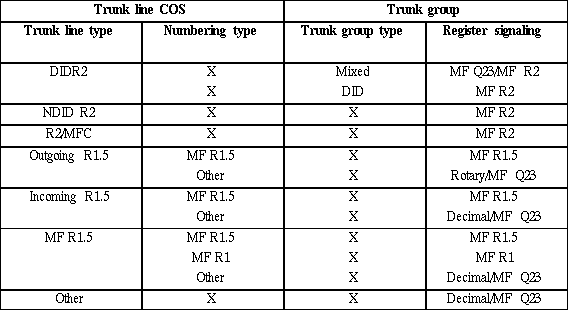
If the trunk line and signaling type declared in the COS do not correspond to the record signaling type declared in the trunk group, an incident is generated (incident 38) and the call is released.
The table above gives the match between trunk group and trunk line COS:
The update of this attribute is automatically performed for resident trunk groups, but it must be performed by management or broadcasting for remote trunk groups.
Implicit Priority
Default priority allocated to outgoing calls.
A priority consists of 2 parameters:
Activation mode:
- 0 = not protected
- 1 = protected
- 3 = protected and preemptive
Priority level:
- 0 (min.)
- ...
- 15 (max.)
(See priority service, or MLPP service).
Activation mode
Default priority allocated to outgoing calls.
A priority consists of 2 parameters:
Activation mode:
- 0 = not protected
- 1 = protected
- 3 = protected and preemptive
Priority level:
- 0 (min.)
- ...
- 15 (max.)
(See priority service, or MLPP service).
Priority Level
Default priority allocated to outgoing calls.
A priority consists of 2 parameters:
Activation mode:
- 0 = not protected
- 1 = protected
- 3 = protected and preemptive
Priority level:
- 0 (min.)
- ...
- 15 (max.)
(See priority service, or MLPP service).
Preempter
YES: this trunk group supports the preemption service.
Reminder: when there is a priority call, if the conditions so allow, preemption makes it possible to release resources in order to set up the call. These resources may be released in routing (channel B for example) or on arrival (set).
Incoming calls Restriction categ.
The Incoming Calls Restriction COS defines a hierarchy with regard to the Minimize service: an incoming call is authorized if the call restriction COS of the calling trunk or called party is greater than the installation value (0 = most restricted COS, 10 = most open COS).
See CALL RESTRICTION SERVICE object.
Outgoing calls Restriction categ.
The Outgoing Calls Restriction COS defines a hierarchy with regard to the Minimize service: an outgoing call is authorized if the call restriction COS of the caller or called party trunk is greater than the installation value (0 = most restricted COS, 10 = most open COS).
See CALL RESTRICTION SERVICE object.
mpt1343 callee number
Function for "Digicom 7" (Digicom7 provides the switching function between the radio channels and external networks. It is controlled by a CSTA server.)
YES: the trunk group is MPT1343. This allows the PBX to redirect any call in MPT1343 format to a group of supervised analog Z terminals. This group number is entered in the routing numbers of the trunk group entity.
NOTE :
The MPT1343 format is a numbering format including the trunk group prefix, supporting several "*" separators and ending with "#". This format is used in the radio domain (in airports) to contact teams that are still designated "fleets". This numbering is retransmitted in its entirety in the protocol.
Overlap dialing
YES: overlap mode in reception (processing of SETUP message without" "'Sending Complete')
Call diversion in ISDN
YES : this option activates the "Partial rerouting" feature for an ISDN trunk group.
CUG List Number
This attribute defines the number of the CUG list assigned to the term.
The value -1 means that this term does not have a list.
CUG Preferential
This attribute defines the index of the preferential CUG in the term's CUG list. By default, this CUG is used for all outgoing calls.
A term may not have a preferential CUG (-1). In this case they must make an explicit CUG request to be able to make a CUG call.
CUG Outgoing Access
This attribute is to be managed only if the term has a CUG list. Otherwise this attribute is not applicable.
YES: when the term is the caller, a CUG call is generated with or without outgoing access depending on the other parameters of the CUG.
NO: for a CUG call, if the CUGs are different, the call is rejected.
CUG Incoming Access
This attribute is to be managed only if the term has a CUG list. Otherwise this attribute is not applicable.
YES: when the term is the called party,
- the CUG calls are accepted with different CUGs if the caller has an outgoing access set to YES.
- in addition the CUG calls are accepted with identical CUG, even if the caller has outgoing access set to NO.